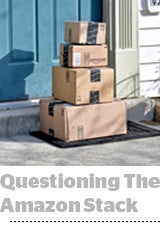
 Direct-to-consumer brands like Mack Weldon, Manscaped and Peloton have expanded beyond their Facebook and Instagram roots – but don’t expect them to start advertising with or selling most of their products on Amazon.
Though Amazon seems like a natural expansion for ecommerce startups, reducing the impact of the world’s biggest ecom platform is a strategic priority. Amazon advertising can boost sales, but it diverts shoppers to an Amazon-owned funnel, and takes over the relationship for fulfillment and replenishment.
Men’s apparel startup Mack Weldon tested campaigns on Amazon and found they competed with its own search ads and product listings, said Brian Berger, co-founder and CEO. “Any brand trying to build up a direct consumer business, you really run into trouble on the marketing side with anything on Amazon.”
And as a sales channel, Amazon can cannibalize a DTC company’s direct sales and siphon customers, which increases user acquisition costs, observed Manscaped’s marketing VP, Ryan Fiore. “The Amazon effect is real,” he said.
Manscaped hasn’t entirely boycotted Amazon. The San Diego-based men’s grooming company uses Amazon primarily in global markets where it doesn’t have delivery infrastructure. And there are enough Amazon loyalists to make it a key sales channel – it’s currently about 15% of Manscaped’s overall business.

But Manscaped also tries to get those Amazon-using customers back, Fiore said. The company uses Amazon-specific tech vendors, for instance, to re-engage Amazon shoppers by email or social media with tactical deals meant to get that customer to the brand’s site, prizing a direct relationship back from Amazon.
Direct brands have to balance effective marketing while ensuring high customer lifetime value. And the more a brand relies on lifetime value instead of one-off sales, the less sense it makes to rely on Amazon.
Peloton sells fitness equipment and class subscriptions exclusively through its own brick-and-mortar and online properties. “We can craft a relationship over the test of time,” said co-founder and COO Tom Cortese.
Selling on Amazon, for instance, means using the Amazon delivery infrastructure. But for Peloton, managing delivery and installation is core to its direct brand proposition and improves customer lifetime value, since customers are more likely to upgrade products or services after a better in-person experience.
Other DTC brands avoid Amazon due to fulfillment issues.
Dream Pops, a vegan ice cream startup, is open to adding Amazon at some point but its frozen treats don’t deliver well with Amazon’s fulfillment centers, said co-founder and CEO David Greenfeld. “Our product is unique enough that I don’t worry about committing a lot to Amazon and then getting cut out by a private label, which is probably something that a lot of food and beverage brands think about,” he said.
The men’s clothing brand Bonobos, which Walmart acquired for $310 million last year, doesn’t sell on Amazon partially because of the channel conflicts – i.e. Bonobos paying to draw would-be direct customers to Amazon instead of its own properties. Also, Amazon’s user interface doesn’t enable the personalized fitting options Bonobos has on its site or app or with its retail partners Nordstrom and Stitch Fix.
“Now that we’re part of Walmart, the competitive tensions have become more explicit,” said Bonobos CEO Micky Onvural. “But it was already something we evaluated and had made the strategic decision not to be there.”