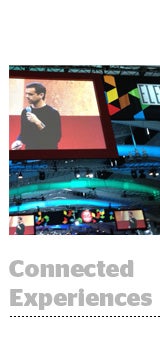
 A denim-clad Jack Dorsey took the stage Wednesday morning at the National Retail Federation’s Big Show in New York, claiming to be a man of “very few words and even fewer characters.”
“We hear [the word ‘technology’] so much it tends to lose its meaning,” the chairman of microblogging mainstay Twitter and CEO of payments app Square told a crowd of brands and the technology vendors seeking to sell them solutions. “At the end of the day, all technology is is a tool. A basic tool saves people time. A good tool gives people purpose and meaning. A great tool makes people love using it.”
Touching on his role as co-founder of Twitter, which recently went public, and Square, which is expected to facilitate $30 billion in transactions this year on behalf of its merchants, according to The Wall Street Journal, Dorsey said, “[O]ne of the things I’ve looked at in my career is, ‘How do we rethink things from a radical sense?’ I find, in our industry, we’re too focused on the tiny parts instead of the broader cohesive wholes. That is where you can create an end-to-end experience.”
Dorsey explored how technology companies can strike a balance between innovation and mindfulness of consumer privacy when developing those experiences.
Focus on the follow-up. Not just the transaction.
“The one thing people take away in every commerce transaction is the receipt. Sometimes, it’s not taken and the reason it’s not taken is it’s not useful. At the end of the day, the merchant has very little information about the sale. That’s why cohesion is important. It removes the seams from all of these transactions. It’s not just the product or service people take away. It’s about what experience they have. There is a lot of focus on transactions — mechanical objects and movements. It’s not about just improving loyalty or CRM or customer relationships. It’s about connecting the dots between those things, that lie between the transactions. … It has to be software that creates great experiences that doesn’t focus all the experience on the transaction.”

New ways to publish.
“We talk a lot about mobile, offline, online commerce. It’s just commerce. We’ve been putting a lot of emphasis into seeing this receipt as a product. As a way to build a communication channel between merchant and consumer. One thing I’d encourage you to think about is, ‘What can we do with this everyday tool that is independent of the product/service you just gave away?’
“We’ve thought about the receipt as an email, text message and Web page, but what if the receipt becomes an application? What if the receipt was a full-blown application? [The Square Wallet app] allows you to open up the app, store credit card credentials once and then see a directory of all merchants around you. We take the geolocation [coordinates] of the phone and register them so when you have Square Wallet running, as you walk into a store, your name and a picture of your face and your ‘most likely order’ appears there on the register. If you recognize your customer by name and what they like, it will feel like a VIP experience. The more you personalize your experience, the more they’re going to feel like, ‘This is where I want to shop’ and come back.”
How you respect consumer privacy in a business incumbent upon “information.”
“Privacy and security is not an end point. There’s no one solution. It’s always changing. You have to constantly be refreshing your technology. You have to give simple, intuitive tools to people so they can control their own privacy and make their own decisions. Otherwise, they will feel like there is all this big data out there and then ‘there’s me.’ If you give them simple controls, tools to glean insights from their own data, then you have something really powerful. We try to give people their data back at Twitter and Square, and display it in a very simple way. It’s saying, ‘This is your data. You need to determine what to do with it.’”
“Pulling” the consumer.
“I think one of the most generous things you can do is recognize [a consumer] as a person. It’s not conceptual — it really works. Starbucks built a great business because they asked baristas to ask the name of their customer. Just being human really works. It’s simple and it works and it inspires a sense of loyalty more than any points system or piece of technology. It’s saying, ‘Hey, Joe is walking in your store and likes cappuccino with almond milk.’ It makes them want to come back.”
Bringing people together
“Going back to physical places, there’s a real asset in having physical space. What technology can do is make that more efficient to connect a customer to a product or service, but it all ends up in a physical space. Even with Amazon, yes, for the past two decades they’ve been ruling ecommerce and put so much into online, but they are starting to look offline and in physical spaces. There’s a real asset there to get to your customer more efficiently.
“It all comes back to meeting your customer in text messaging, online, in the store. Me walking into a physical store should look exactly the same as me engaging with the online store. How do you take online assets to point people to the physical? That’s what you have to think about. People still crave a local, personal experience and online can help point them there. … Twitter is best when it encourages people to get together physically. You see that with the Arab Spring and the Iranian election. It was using it as a tool to get together and it’s happening with commerce as well.”