

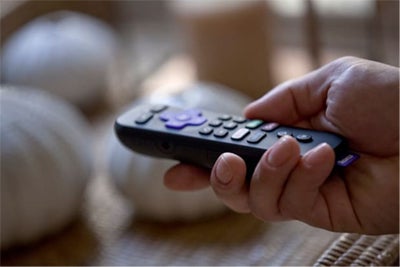
Like other OEMs, Roku has built an ad sales business on top of its streaming hardware. But it never actually manufactured its own TVs – until now.
After denying the rumors last year, Roku recently announced plans to produce a line of Roku-branded smart TVs, available in the US this spring.
Proprietary TV sets are a “natural and logical next step” for Roku’s streaming business, Kristina Shepard, head of US brand sales, told AdExchanger at CES in Las Vegas.
“Our ultimate goal is getting into more US homes,” Shepard said.
Although Roku’s hardware revenue has been on the decline since 2021, platform revenue, which includes content distribution and advertising, is on the rise – and launching its own smart TV line will help support its platform business with direct access to crucial targeting and measurement data, including automatic content recognition (ACR) data.

Zooming in on ACR
Roku, which just hit 70 million active accounts globally, already collects user data and viewership information, including ACR data, from its OS integrations with OEM partners, including TCL. But by owning the TV hardware itself, Roku has access to and control over all of the data generated, including TV viewing and shopping behavior.
With Roku TVs, the company can give brands more granular targeting data and closed-loop measurement reporting for their campaigns, including where or through which retailer a product was actually purchased, Shepard said.
“We want to make sure brands can use our first-party data – including ACR – to target their audiences and tie ad exposures to conversions and sales across different retailers,” she said.
Other smart TV OEMs have had the same idea.
VIZIO, for example, now makes most of its revenue from ACR and ad sales after merging Inscape, its ACR biz, with its ad sales unit, and LG Ads has shifted its business from analytics to selling media based on ACR data.
And then, of course, there’s Amazon, which expanded beyond smart remotes and announced the first Fire TV smart TV line in 2021. That gives Amazon quite the head start.
But Roku has ambitious plans for its data business, which includes the launch of its own clean room last year, Shepard said.
Although there wasn’t much adoption of Roku’s clean room at first, “we’ve been seeing a lot more traction pick up in the last six months,” Shepard said, “both from agency holdcos and direct clients, because brands are getting better at using their own first-party data – and now they want to monetize it.”
Roku’s clean room allows advertisers to match their audiences with Roku’s first-party and ACR data in a way that’s privacy compliant, said Shepard, who noted that all Roku TVs will ask for consent to track content consumption data when consumers first install their TVs.
Retail reckoning
Beyond the data play, Roku always has its eye on measurement. Owning the hardware and software gives Roku purview into the path to purchase, Shepard said.
Manufacturing its own smart TVs gives Roku more control over its own ad inventory. For instance, Roku can integrate brands directly into the Roku home screen, including through content recommendation tiles and new ad units, such as the “billboard” ad units that appear on the “Roku City” screensaver.
Roku can also work more directly with brands on special promotion deals. For example, brand partners can “own more of the [messaging] on the Roku platform when consumers activate their devices,” Shepard said.
These types of executions are trickier to execute with OEM partners, because the end seller has the last say as to what elements are included before it’s sold. But now, Shepard said, “we’re the end seller of our own TVs.”
This level of control over its ad inventory is integral to Roku’s integrations with retailers, including ensuring product availability and competitive ad separation.
Proprietary smart TVs will also enhance Roku’s new partnerships with Walmart and Kroger, Shepard added.
Getting in market
Still, the hardware market is a tough nut to crack. People don’t buy new TVs every day.
Hardware is a far less profitable business than software and ad sales – and, at worst, a loss leader, because consumer adoption takes time.
Roku is also entering a market already populated with competitors that have been manufacturing TVs for years, including LG, Samsung and VIZIO.
But, for Roku, better late than never. One in every three smart TVs sold in the US is powered by a Roku OS, Shepard said, and the company expects that number to keep growing with the launch of Roku TVs. Roku declined to share the current growth of its partner-branded TVs compared with the rest of its existing hardware business.
In other words, watch this space, Shepard said. Hardware will help boost the advertising business.
Roku’s main plan, she said, is to “[give] advertisers the data and measurement they need and expect from streaming to be able to drive higher brand affinity and purchase intent.”
Article updated 1/17/23: A previous version of this article incorrectly stated that Roku’s partner-branded TVs are the fastest growing segment of its player business.







