 The moment for “convergence” between TV and online video is starting to seem more real, but video ad tech firm YuMe believes that programmatic sales methods won’t be a substantial part of the conversation around television-style branding campaigns for many years to come.
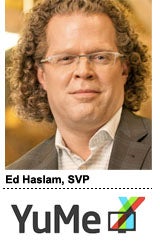
“We do have a small amount of ad sales coming to us through programmatic channels,” Ed Haslam, YuMe’s SVP of marketing told AdExchanger. “Buyers have been conditioned to buy premium through a rep, like they do with TV, and to get direct response inventory through platforms and programmatic. A buyer doesn’t know what you are when you do both.”
Often mentioned as a likely IPO candidate, along with Adap.tv, especially since last month’s S-1 filing by Tremor Video, YuMe is among the few video ad tech companies to continue to look askance at programmatic sales methods. But as Haslam tells it, the stance helps YuMe tell an easy to understand story to TV buyers who are more comfortable dealing with comparatively uncomplicated CPM-based formats.

Asked about its own financing ambitions and its current finances, a rep declined to comment, citing Redwood City, CA-based YuMe’s status as a private company. CEO and founder Jayant Kadambi was unavailable for comment, as a company rep said that he was with family in India. (A little YuMe history: Kadambi was replaced as CEO for a three year period beginning in 2008 by Michael Mathieu, who became CEO/chair of similarly-focused video/TV ad player, SET, formerly Affine Systems, last summer.)
YuMe has staked out a claim with both publishers, through its Connected Audience Network and ad serving software, and with the demand side, through data-related tools like its Placement Quality Index. And there is its Audience Amplifier, which helps buyers plan ways to balance their TV ad spend with comparable digital video placements.
Building up its data capabilities is YuMe’s focus at the moment. Earlier this year, the company acquired Crowd Science, which came with its own sell-side platform called Citrus. As Haslam explained, Crowd Science possessed a similar focus on analytics that would show “brand receptivity,” as opposed to performance metrics best suited for direct response ads.
“Brands wanted to move beyond demo targeting,” Haslam said. “What we got with Crowd Science was a third party data solution that we believe will be much more accurate and drive campaign effectiveness. Even more important than the data were the machine learning capabilities as we start to build ‘likeness’ and look for patterns across all of our publishers.”
The data that YuMe accrues from its close work with publishers is what makes it attractive to marketers and buyers, said David Klein, GPD for media shop TargetCast tcm.
“The primary reasons come down to their ability to provide research and true measurement,” Klein told AdExchanger.”The YuMe team has continued to push the envelope on ways for us to better tie our traditional and expensive TV activity to the more targeted and efficient video activity that we are placing more and more of. They have provided us with critical knowledge and learning across the second screen environments allowing us to become smarter and more nimble for our clients.”
Although eager to partner with other video ad players like Ooyala, which used YuMe’s ad management system, as well as a long-standing relationship with Nielsen’s Online Campaign Ratings, the company doesn’t expect to jump into the viewability consortium that was struck a few weeks ago by TubeMogul with BrightRoll, Innovid, LiveRail and SpotXchange to support Open VideoView, an open-source metric for in-stream video ads.
For one thing, Haslam said, ads that run through YuMe’s system are already “100% viewable,” adding that it’s up to the brands to set the definition of viewability.
“We’ve looked at the consortium and we applaud and support any standard-setting in the marketplace,” Haslam said. “But we also believe that it’s our objective to innovate on things like viewability. If there’s something we can easily implement in our SDK, we would consider it, and we would consider contributing to the idea and definition of viewability. But we’re a software company, and so whether it’s viewability or some other issue, we’ll embrace any standard and extend it.”