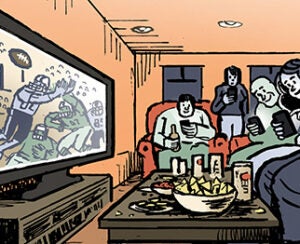
 TV is still the king of media, but the social “back channel” is now an indispensable part of its ambience. No surprise then that advertisers are hungry for media vehicles that bridge the two.
A number of companies are positioned to feed that appetite, but Twitter is the frontrunner. Its Amplify program lets broadcasters sell ads that “ride along” with short-form video content seen by Twitter users.
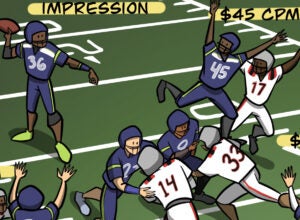
Participating advertisers cut ultra-short versions of their spots for this opportunity. A 4-second post-roll purchased by Heineken might follow a 12-second NFL instant replay, with the resulting revenue shared between Twitter and ESPN. As with all Twitter ad formats, the impressions are a blend of paid and earned media.
“I think Twitter’s ad experience is a lot better than others,” said Brian Terkelsen, CEO at MediaVest USA. “Their ad experience in the social sphere is incredibly compelling. People are watching pre-rolls, and some people are actually watching post-rolls.”

Networks are taking notice. The Amplify program keeps adding partners. A few weeks ago it signed CBS, and just yesterday roped in BBC Global News, which will produce a series of “#BBCTrending” in-tweet video reports. Twitter is now working on a self-serve option letting networks and advertisers manage the creative and media targeting components.
Facebook has been less progressive. Earlier this year it repeatedly delayed, and then indefinitely postponed, the rollout of a splashy new video ad format. The auto-play ads would have functioned much like a traditional online homepage “takeover” of the sort one might have encountered on Yahoo circa 2006. The price tag was rumored to be $2 million, nearly the cost of a Super Bowl spot, with all Facebook users seeing the same ad.
Mark Zuckerberg ultimately balked at the user experience implications, according to rumors, but perhaps Facebook was also responding to an unspoken challenge from Twitter to seek more innovative ways to grab TV ad demand.
“They’re struggling, I think,” said Doug Chavez, SVP for emerging media at Universal McCann Worldwide, of Facebook’s TV ambitions. “Twitter has been really good at doing acquisitions like Trendrr and Bluefin. They are gobbling up folks with this real-time data. Facebook will have to work harder to get some of that.”
But while Twitter has already nabbed some of the most significant startups in the social TV bucket, Chavez says it’s early days.
True, Facebook hasn’t yet engineered its own clever catchment system for TV spend – a la Twitter Amplify. But some of its partners are working on it. One example is a “TV-synced” ad product from Facebook preferred marketing developer Optimal.
Optimal, which was recently acquired by Brand Networks for $35 million, partnered with TV ad-monitoring vendor Civolution to roll out the targeting feature. Civolution monitors hundreds of cable and broadcast and can identify which ads are running in what markets. The company claims its technology can identify an ad within 5 seconds of its airing, and that it detects 600,000 TV ads per day – matching them to its database of 54,000 spots.
Using that feed of “live” commercials, Optimal can then bid on Facebook Exchange to secure placements for those same brands – or their competitors – while the TV ad is still airing. The TV monitoring and ad execution happens at a DMA level, taking into account things like tape delays.
Optimal’s pilot advertiser, an unnamed entertainment brand, reported 60% higher click-through rate for News Feed placements, compared to an unspecified “control group.” Facebook ads targeted to a competitor’s TV ad saw 35% higher CTR.
Optimal is not the first company to enable bidding on digital ads based on real-time TV ad creative. Last year Civolution partnered with DG to enable a similar capability within digital video ads.
But for Facebook’s platform, it’s a start.