The lack of consistent TV measurement is setting nerves on edge – at least to the extent that programmers, including Paramount, are now working with their competitors to find a solution.
Paramount, which is part of a new joint industry committee (JIC) to devise a cross-platform TV measurement standard by 2024, held a conference in New York City on Thursday, which included a pulse check on the JIC’s progress.
As an industry, “we can’t compete on measurement standards,” said Kelly Abcarian, EVP of measurement and impact at NBCU, which has also been pushing for more collaboration between broadcasters.
First, “we need to make sure measurement is accurate,” Abcarian said. “Then, [programmers] can compete on pricing and selling inventory.”

But there are notable absences from the JIC’s membership, including YouTube, which recently came out with its own set of preliminary measurement requirements, including using the Media Rating Council’s two-second viewability standard to measure TV impressions.
The bare minimum
For now, though, the JIC is doing the best it can with what it has.
As a first step, the JIC agreed on baseline currency standards earlier this month. Shortly thereafter, Paramount shared some advice for programmers and agencies on how to start actually using them.
“New currency is here,” said Michele Stone, Paramount’s VP of advanced audience product and planning. “But currency vendors need to share their data in a way that programmers can integrate it into their already-existing workflows.”
Video currencies need at least two years of historical viewership data on hand so that programmers and agencies can assess their household reach and audience representation. Currency providers should also be able to guarantee reach based on both demos and advanced audiences, and they need to be integrated with clean room technology for speedy and privacy-safe data sharing.
Interoperability is an especially big deal for programmers and agencies. Currencies all have their own sets of viewership data, and without some translation layer in between, marketers can’t get reach and frequency counts across platforms.
Not to mention how much it costs buyers to transact on multiple currencies that cover only certain sections of TV viewership.
Only when video currencies reach an equal playing field can agencies start to honestly evaluate which currency partner they prefer, said Sam Armando, director of national video intelligence at Publicis.
But getting there is easier said than done.
Helping agencies prepare for all these new currencies is the industry’s “heaviest lift” right now, said Ramsey McGrory, chief development officer at Mediaocean.
And for the sake of streamlining the process, programmers and agencies both have strong opinions about what (and who) doesn’t belong in the TV measurement conversation.
YouTube? No, thanks.
Buyers and their broadcast partners believe that YouTube’s push for a two-second viewability standard for TV ads could hold up the industry’s move toward new currency.
Both parties are concerned that if the proposal gets enough traction, YouTube will be able to garner more connected TV market share by making short and dismissible video ads count as top-dollar TV impressions.
The price advertisers should have to pay for an ad that someone can skip shouldn’t be the same price they would pay for a premium 15-second spot on TV, said Kelly Metz, managing director of advanced TV activation at Omnicom Media Group.
Plus, most of YouTube’s content library is user-generated content.
YouTube is calling for an ad exposure in a video of someone’s cat to be counted the same as an ad in a primetime TV drama, NBCU’s Abcarian said. “Marketers aren’t spending billions just to reach people – they want to have an impact,” she said.
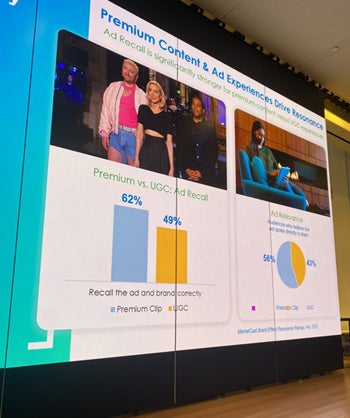
That concern is why NBCU recently added a content quality index to its measurement portfolio. Based on research from MarketCast, the average brand recall for ads that appear in TV spots hovers around 62%, compared with just 49% for ads in user-generated content.
“Measuring reach should be about quality, not just quantity,” Abcarian said.
Setting boundaries
But aside from YouTube, the TV industry has another concern: accounting for individual viewing within a household as currency providers incorporate co-viewing into their solutions.
ISpot, for example, led a $16 million venture funding round in TVision late last year, which uses a panel to measure attention on TV commercials.
Co-viewing is a helpful measurement input, but most agencies believe that it’s too nascent to be considered scalable. Person-level TV measurement is still mostly based on extrapolation and data modeling. (TVision, for example, models its attention metrics using a small opted-in panel.)
Agencies prefer that one-to-one targeting and measurement be based on households, not individuals, because it’s more deterministic. For example, it’s easier for a marketer to target a household with cats than it is to target a TV commercial to an individual cat lover.
“I am not content with person-level measurement being applied to household-level TV targeting,” Metz said. “It is wildly inaccurate and based on tiny panels, and I do not recommend it for precision in targeting and measurement.”
Omnicom isn’t the only agency opposed to making inferences based on small data sets. GroupM doesn’t agree with using data modeling for automatic content recognition, for example.
Let’s go already
But aside from hating on cat videos, the TV industry does seem to agree that, despite valid concerns, new currencies won’t take off unless the industry actually starts using them.
“We’re done just talking about transacting on alternative currencies – we need to actually do it,” said David Campanelli, chief investment officer at Horizon Media. “Advertisers need to make meaningful commitments against alt currencies at this year’s upfronts.”
Programmers are on the same page about picking up the pace.
C3 and C7 metrics (cough, Nielsen as we know it) will sunset in 2024, which is also when the JIC’s standards should be complete, said John Halley, president of Paramount’s ads business.
“We want this business to transform and evolve with as minimal chaos as possible,” Halley said.