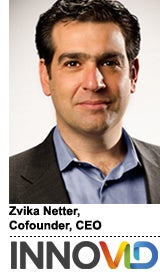
 Interactive video ad tech startup Innovid has changed significantly since its beginnings in 2007, when it had nothing to do with advertising.
Though it has since helped companies like Toyota, Chrysler and Sony Pictures serve up dynamic and interactive pre-, mid- and post-roll video ads, and has worked with both Roku and Sony Playstation to deliver over-the-top ads, it was founded by a group of guys with “no media/ad tech backgrounds whatsoever,” said Zvika Netter, Innovid’s cofounder and CEO.
Innovid’s initial incarnation was as a platform that dissected video content frame-by-frame and extracted metadata. “We spent three years building the platform and interacting with studios such as MTV and CBS to change the whole format of how news, sports, cooking shows (looked in digital),” Netter recalled. “It was a lot of cool, fun stuff, but absolutely no revenue.”
No revenue, however, isn’t a sustainable business model and in 2010, Innovid began its exclusive focus on advertising, working initially on pre-roll ads and now partnering with a number of video ad networks, premium publishers and tech platforms to serve interactive, cross-screen placements.
Netter spoke with AdExchanger for the next installment in a series of Q&As evaluating the video ads ecosystem. Past interviews have included: BrightRoll, Ooyala and SpotXchange. This series will also include Videology, Vindico and more.
AdExchanger: Describe the Innovid platform.
ZVIKA NETTER: Our Atom platform runs pre-roll (interactive iRoll) and other formats across web, mobile, connected devices and we’re extended that into the TV world. We’re not active on the traditional TV dollar side, but we have insight on the digital side, and we absolutely see digital video budgets increasing where we are active with things like addressable, personalized and dynamic video.

We demonstrate that through pure data and level of engagement, and time spent metrics, which we convert into ROI. We made a decision we wont touch anything outside of pure video.
What’s “pure video?”
In-banner video is not video to us. For us, it needs to be in-stream, in a player, before content, during content, after content. We’re taking the TV model and taking it to the next level in digital.
Innovid signed on recently as an exclusive partner for Facebook’s ad server Atlas. How’s this transpiring in light of the LiveRail acquisition?
We signed an exclusive deal that whenever an Atlas customer needed a video solution, everything – the engine, ad server, iRoll – that it would run through Innovid, and it’s a deep integration with Atlas. We can start a campaign on Atlas, traffic it, it will run through Innovid and the data will go back to the Atlas dashboard. It’s a deep and strategic relationship.
I can’t talk too much more about it, but Facebook is extremely serious about it and they’re rebuilding their entire platform. And I think they’re investing in the whole tech stack with the LiveRail acquisition. We have many more direct to client relationships though, independently.
Do you have a DSP?
We made the decision to stick to the technology and commit to it. That’s the fixed CPM and the fact that we’re not tapping in to the media business. We’re not a DSP. We have all the functionality of a DSP, but a DSP is a commodity – you plug into LiveRail, AppNexus, any exchange really. We tell our clients that the way that DSPs operate today, it’s a media business. It’s not a platform business. So when Chrysler, for example, runs ads on TubeMogul, a DSP, Hulu, YouTube, CBS, AOL, Yahoo and across mobile, Roku, etc., 100% of those ads are going through us, being delivered, measured for verification and fraud. There’s no way they make money from video ad serves, though. The only way to make money for everybody else is to sell media through a DSP. Video ad serving is a terrible business in terms of margin. If all you do is traffic ads and run them and collect reporting, it’s a low CPM product and you’re providing managed services. You’re basically outsourcing the work of the agency.
How does Innovid make money?
We make money on iRoll and VOD and connected TV, where all the other players are going after the media dollars. We came to it not from an ad network perspective where there was tons of money to be made in the early ad net days. We made a decision we would be 100% technology focused, 100% media agnostic and that’s a very important distinction, because everyone sees the marketing and SaaS platform-model take off. There’s so much clutter and a lot of VC dollars are going into marketing, which hurts the whole industry.
Are you saying managed services and platforms are mutually exclusive?
Many of these guys are our partners and some are even our clients. TubeMogul, for instance, uses our iRoll technology, white labels it and that generates revenue for us, too. But at the end of the day, many of them are managed services. They’re a dashboard to buy media programmatically, and no one at the agencies besides the trading desks really has capacity or bandwidth to run this. At the end of the day, they hand TubeMogul an I/O, say “I’m looking to buy male/female,” they transact on that and they come back and say “you got this percentage viewability” and there’s so much room there to make money because it’s percentage-based.
The Innovid model is a fixed technology CPM. We don’t care how much money you spend, we care how many impressions went through our system, so it’s all volume-based. And we don’t have any media affiliation.
What’s your volume and headcount?
In 2013, we ran… about half of $1 billion. The media was not transacted through us and it does not flow through us, but if you want to compare apples to apples from a scale perspective, it’s comparative to about half a billion. We have 135 employees and 70% of our revenue comes from the US with 30% outside of the US. Global markets are growing insanely fast. We raised about $30 million to date and Sequoia Capital is our lead investor.