

As Gartner analyst Martin Kihn recently predicted, the big enterprise marketing clouds are beginning to pursue divergent product strategies with clear points of distinction.
While Salesforce heralds its CRM data and hooks into other categories like sales and commerce, Adobe’s differentiator is creative with growing emphasis on digital experience.
In the case of Oracle, which houses its campaign management capabilities (Responsys, Eloqua and Maxymizer) separately from its Data Cloud consisting of Datalogix, Crosswise, AddThis, Moat and the BlueKai DMP, its pitch centers around its data and services layer.
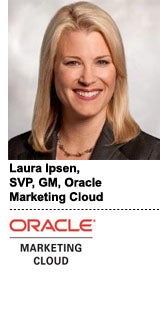
“We have over 2 billion unique user profiles, so the scale we have to mobilize our customers and drive AI everywhere harnessing our data is super compelling,” said Laura Ipsen, SVP of the Oracle Marketing Cloud (OMC), on the eve of Oracle’s annual confab, Oracle Open World, in San Francisco. “This is where we’re very different.”
Ipsen and OMC product marketing director Austin Miller spoke with AdExchanger.
AdExchanger: How has Oracle’s history as a database company affected OMC’s go-to-market and sales strategy?
LAURA IPSEN: Our focus is on building functionality and adaptive intelligence into all of our applications. Not just bolting things on, but doing a full integration across our stack. It’s also a matter of cost savings – the amount of effort on CMO’s IT resources to integrate all of these technologies that meet their business needs, have become much more challenging not just for the CMO, but CEOs and CFOs.

What do CFOs obsess with? Risk. If the technologies we’re building leveraging artificial intelligence allow marketers to manage, mobilize and monetize data in more strategic ways than anyone else, that helps drive the entire company. Our strategy is to help them manage their business, manage risk and drive revenue growth.
How does this play to Oracle’s emphasis on data as a competitive differentiator?
IPSEN: Our whole company is built on being the best in class at managing data. Our competitors may come from CRM or content, but if trust ultimately lives with data, it’s what we were built on. And we can connect experiences of the customer to the broader issues of the company through back-office applications like ERP and HCM [human capital management].
We have our own infrastructure, platform and software-as-a-service models, which means we can innovate faster because we don’t have to worry about operating on somebody else’s infrastructure. We build security everywhere.
Why did Oracle separate its Marketing and Data clouds if the two cohabitate?
IPSEN: The Data Cloud is about buying and selling data, but was created separately from the Marketing Cloud from the beginning to move with speed. But, of course, there’s the opportunity we have to sell together.
Eric Roza [head of the Data Cloud] and I are great business partners and we understand the approach to our customers in terms of what they need from the data side and the Marketing Cloud. As we all drive forward new opportunities in the cloud, we’re very strategically aligned and conjoined.
AUSTIN MILLER: The Data Cloud is not only a data-as-a-service business, but the underlying data that will inform the AI embedded in all of our various applications.
While offline purchase data is very interesting to us with Datalogix, you also have interest in that from [the] Service and Sales Cloud. Having the Data Cloud in a different unit allows us to spread out those services across the entire CX application infrastructure, not just Marketing Cloud.
How do you approach your sales strategy?
IPSEN: We go to market with laser focus on our B2C customers because they have unique needs. We may begin with Responsys and extend that with Maximyser and BlueKai. When someone comes to us to buy BlueKai, the DMP, we’re working collaboratively in the go-to-market with the Oracle Data Cloud. On the other side, our B2B go-to-market centers around Eloqua.
A lot of B2B customers are focused on getting closer to not just business customers, but the consumers of their products. So now, more than ever, we’re able to share the learnings from our B2C customers with our B2B customers.
Speaking of AI, what is Oracle’s value proposition here?
IPSEN: We don’t have a named persona for AI. We’re building it so it’s embedded in our applications everywhere at the platform level and it becomes a natural part of the platforms they’re using. We think AI should just be part of how you build software versus this virtual application that’s bolted on.
For example, a lot of our retail customers are leveraging artificial intelligence capabilities we built into Responsys like send-time optimization and deep personalization. The intent [of purpose-built AI] is for marketers to predict what consumers want next and be able to offer them new products or experiences.
What sort of services does Oracle offer? Is it mainly about integrating Marketing Cloud components?
IPSEN: The services ecosystem is evolving. Along with the traditional services players, whether it’s the large Deloittes or Accentures, really boutique partners like Relationship One or really strategic partners like Merkle, we’re all finding our way.
These tools and technologies we create are only as good as the services that continue to deliver them. Being able to integrate more solutions and onboard new innovation more quickly is part of our strategy beyond just services.
Our AppCloud aims to take the pain out of integration and for some of these consulting services, allows them to build custom integrations as well. We hear a lot of chatter about some of our competitors pushing out partners and services, and we really enjoy having a broad ecosystem of AppCloud partners.
We’d love to think OMC is their full stack, but our specialty is integrating through open APIs.
Can you give an example?
MILLER: A big initiative for us is the Oracle Integrated Cloud Stack. The old way of doing this was that you employed an army of consultants to build point solution integrations, which was tremendously expensive and not that efficient because it required a lot of maintenance.
So we focused on creating one point of integration that plugs into a central data bus, allowing clients to move data seamlessly between applications, which negate the need for multiple integrations between point solutions.
Interview condensed and edited.







