

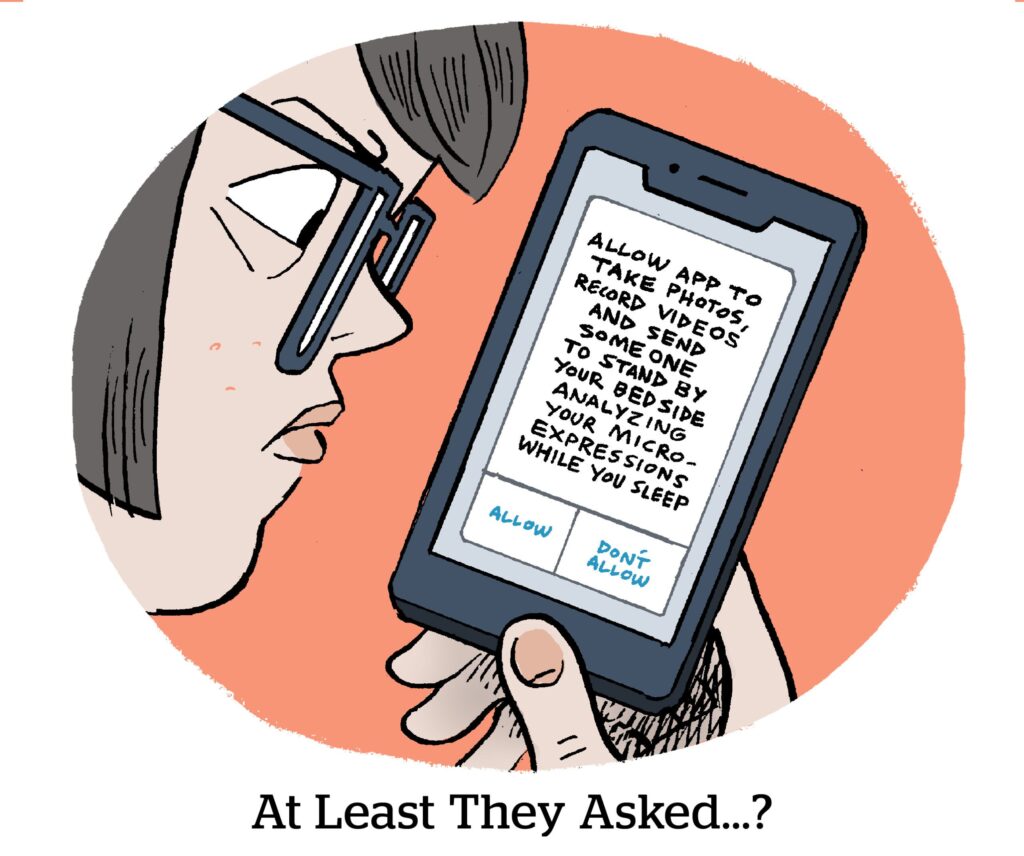
Last week, I had a dispiriting experience with the AdChoices program.
I couldn’t opt out of seeing an ad promoting Hogwarts Legacy, a game I have no interest in, for all the love, money or clicks in the world.
I was later informed by the Digital Advertising Alliance (DAA), which manages AdChoices, that the issue I’d encountered “was entirely unrelated to the AdChoices program” and that the choice mechanism I had interacted with “was not part of the industrywide controls managed through the AdChoices program.”
Huh? 🤨
I suggest you strap in.

Choices, choices, choices
AdChoices is the DAA’s self-regulatory program for online interest-based advertising (IBA).
As part of that program, the DAA created a tool called WebChoices, which scans a person’s browser settings to see whether cookie tracking is enabled by DAA member companies. People can use WebChoices to opt out of interest-based advertising company by company or they can opt out across the board (albeit only among participating companies).
There are also a bunch of other caveats.
The opt-outs only apply to interest-based advertising. They don’t apply beyond the current browser someone is using. Opting out of IBA doesn’t mean a person won’t still receive other types of advertising from participating companies, and, as per the WebChoices site, “these companies may still collect information for other purposes consistent with DAA principles.”
Oh, and preferences may be stored in opt-out cookies. So if you use a browser that blocks cookies, your choice preference “may not be effective.” If you delete your cookies, you might end up removing your WebChoices opt-out preferences.
And on and on … 😵💫
A gateway?
Returning to Hogwarts (so to speak), when I clicked on the AdChoices icon embedded in that banner ad on CNN’s website last week, it turns out I wasn’t interacting with WebChoices. I was interacting with a consent tool created and operated by Google, the entity that served the ad.
Apparently, according to DAA CEO Lou Mastria, “scores” of publishers and ad networks have adopted the AdChoices icon to use as “a consumer gateway for information and control.”
 In other words, they use the AdChoices icon but don’t use the official DAA consent tool.
I’ve been writing about ad tech and data privacy since 2014, and I was today years old when I realized that a large percentage of companies that use the AdChoices icon don’t also use the DAA’s opt-out mechanisms.
Sometimes the AdChoices icon links to a company’s privacy policy. Sometimes the icon opens a homegrown consent modal, while other times the icon opens a modal that was created by an advertiser’s third-party partner. And yes, in some cases, the icon does link to WebChoices.
I’m willing to be proven wrong, but, to me, this doesn’t sound like a coherent experience that regular people should be exposed to. 🤷
What happened?
But none of this helps to answer the question of why Google’s consent tool didn’t allow me to opt out of seeing an ad for Hogwarts Legacy on CNN.com even after I tried to do so 47 (!!) times.
I asked Google what was going on and was told by a spokesperson: “We deeply believe that consumers should have control over their ads experience…” (and so it continued in that vein).
“We build all our products to respect consumer choice as much as possible. We also recognize blocks aren’t 100% perfect so we try as best we can not to set the wrong expectations with consumers.
The circumstance you encountered could be the result of a number of factors, including how a campaign was set up, what type of browser or anti-tracking tools you may be using or whether you are signed in or out. Whatever the reason, we think there should be a better experience. How to address this is on our mind and we hope to have more to share here in the future.”
So, not much of an answer.
And I’d argue that if Google, the largest server of ads on the web, has a confusing consent UI, then the notion of self-regulation is in trouble.
 Not to mention that the temperature in DC is rising.
Can Self-Reg Survive?
And so I asked the DAA for its view on what the role of self-regulation in the ad industry will be in light of state privacy laws coming into effect and the ongoing push in Washington to pass a national privacy standard.
Unsurprisingly, Mastria’s view is that self-regulation will “be critical no matter what happens” in Congress or at the state level because it’s able to keep up with the rapid pace of technological change. And there’s also a place for “robust FTC-managed self-regulation” even after there’s a federal law on the books because the commission has a big job and limited time and resources for enforcement.
Perhaps.
But in a world where people casually toss around the term “surveillance advertising,” the appetite among lawmakers and regulators to support self-regulation may have passed. 👋
As one ad tech executive put it to me recently: “Self-regulation ‘works’ … until it doesn’t.”
Let me know what you think! Drop me a line at allison@adexchanger.com. My DMs are also open for privacy memes and dad jokes.







