
2012 was good to Rocket Fuel, as the company benefitted from rising advertiser interest in retargeting and real time bidding. Oh, and it probably didn’t hurt that the company was named an early partner on the Facebook Exchange, which has rapidly grown to a rumored 7 billion daily impressions.
During the year just ended Redwood City, CA-based Rocket Fuel hit $107 million in gross revenue, an increase of 238%, and it more than doubled its staff. Meanwhile the number of new advertisers grew 93%.
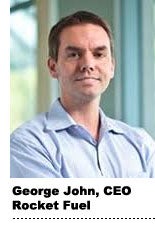
Among Rocket Fuel’s innovations, says CEO George John, is the ability to balance contextual and social behavior to avoid wasting time and ad spend pursuing users who aren’t interested no matter how many times they see an ad. “Thankfully marketers have become more serious about delivering quantifiable results through digital advertising and we have been here to really optimize those dollars spent,” says CEO George John.
George John spoke with AdExchanger about the state of the company, customer demands, and future hiring goals, which include adding 300 people in 2013.
What do you think the growth numbers you are putting out today say about Rocket Fuel’s model?
GEORGE JOHN: We hope this means that we were right about everything — that advertisers would be looking for more efficient results and listening to the numbers rather than following what they had been doing for years, both on and offline.

We have seen that pay off now. The broader trends in automation and Artificial Intelligence make this even more impressive to me. Our pop culture is embracing AI as a real technology rather than a hypothetical one. From the Mars Rover to self-driving cars and products coming out at CES, this is now a reality.
What markets or industries have boosted your revenue this year?
Growth was across the board. Automotive, travel, retail, financial services, telecommunication all saw growth. Those all scale up their spend with us once they see it working.
Almost all automotive companies are customers of Rocket Fuel in some way now. That was not the case in 2010 when we were trying to knock on their doors and court them.
Europe has also been a great growth story for us since we launched those offices in 2011. It really flourished in 2012. We opened up London, Germany and Netherlands, which was 10% of our revenue.
What were your challenges in 2012?
The challenge for the year has been how to bring people in fast enough without breaking the company and losing that startup connection with clients. This year I’m also grappling with the challenge of adding 200 to 250 people to the staff — and that is quite a chore. [Rocket Fuel later corrected the number of projected hires to 300]
I am even thinking about creating a code to help me make flash cards to keep employee names straight. I don’t want to be embarrassed I can’t remember them.
How have advertiser demands changed over the last year?
It has been more of a shift than an all-out change. Marketers are becoming more demanding across the board. A year ago you might be spending a large chunk on portals, another chunk on sites that everyone agrees you just need to be on, while the rest would have specific metrics that you want to hit. But in the past few months and years, people are reevaluating all the money that they spent without the metrics supporting it before.
With Facebook launching its exchange, advertisers have shifted from using it to draw Likes to now being a component in advertising on a larger level.
There is a trend toward “getting real.” Even in mobile there has been a lot of experimentation about building their own app, including games in the app. Now people know what works and are allocating budgets not just for online but specifically for mobile phones, tablets and other areas.
What industry changes do you see on the horizon?
I would definitely expect more money going to FBX. A few analysts are already raising their expectations because of this advertising offer. I think it will be good for the industry since real-time bidding has really gained a lot of momentum and credit lately.
I would like to see more publishers use this to compliment their overall strategy online.
How do your offices abroad benefit your company?
The offices are primarily pods of account managers, sales and analytics. Initially we were just in the U.S and Europe. The advantage is that we are excited that robots are behind the data but there are still humans to handle the questions, concerns and demands of our clients. We want to have that human relationship. We tried initially to have service just here in the U.S. and it has turned out to be better service for clients if we are spread out.
Since your algorithms are constantly changing, is there a point when that knowledge is tapped out and no one company has an edge?
If you look at other companies that rely on technological superiority — I think of Cisco as one — they were a hugely successful company that both bought technology from others and innovated organically. I see the evolution as similar here. There are a few things we are doing to protect our product and keep the edge, and we are hiring to keep innovation going. We also have the privilege of being in this sector for this long — some algorithms and technology just can’t be written well-enough without the time to gather all this data.
We are also making investments across social, mobile and video to help advertisers understand how these areas can drive their business and keep us as relevant as possible.








