
 “Data-Driven Thinking” is written by members of the media community and contains fresh ideas on the digital revolution in media.
Today’s column is written by Ernie Cormier, CEO at Nexage.
At first blush, there are two strategic imperatives in digital advertising that appear to conflict.
First, marketers are catching up to the massive consumer shift to all things mobile. Second, there is a strategic emphasis on cross-screen to create a holistic and powerful experience as consumers move among devices throughout their day.
The conflict comes from jumping into cross-screen without fully mastering mobile — especially as consumers increasingly use mobile as their primary screen.
The basic crux of the issue is that as mobile emerges as the dominant and critical digital channel, it becomes competitively perilous to underperform in mobile, whether as a separate channel or part of a fully operating cross-screen capability. I recognize that companies are running initial pilots now and marketing messages may suggest that the market is far along.

But in reality, many marketers are still working to understand and master the important differences between mobile and online. For example:
• Many agencies are just now accelerating their investment into mobile-specific creative (biased toward rich media and video).
• Buyers, trading desks and agencies are just now adapting to a cookieless environment where their ability to acquire a reliable mobile ID, create cross-screen linking and be able to retarget cross-screen is in the early stages.
• Marketers and agencies are just now uncovering the immense value of reaching premium audience through mobile apps, an ecosystem that is unique to mobile.
I will add to this list a simple outcome of math and logic: As mobile use eclipses online, as online adapts to an endangered cookie and as publishers increasingly use applications to enhance customer experience and engender loyalty, mobile will, in most cases, be the reference architecture for digital.
Mastering mobile is not simply a mobile objective; it is a fundamental objective of advertising moving forward. It’s also a fundamental component of being able to operate well cross-screen.
Ultimately, marketers can’t view mobile as a hobby, but they also can’t miss the strategic opportunity to engage across screens.
So how do we develop a practical strategy to execute cross-screen while still climbing the mobile learning curve?
The Stages Of Mobilizing Cross-Screen
The best way to look at this is through the lens of stages, removing the temptation to create a philosophical debate about what is more important, mobile or cross-screen. The goal is to look at the practical reality and put in place steps that make both mobile and cross-screen work well.
Ultimately, marketers and agencies will both fully master mobile and run fully integrated campaigns across media and tuned to the consumer. But that will take time and effort across different dimensions, including (but not limited to):
• Reliable mobile IDs from which to create cross-screen linking
• Cross-screen retargeting
• Mobile-specific creative (static, dynamic, custom and native)
• The ability to optimize media mix across channels in near real time and at the individual consumer level
• The ability to organize these assets and capabilities at scale to run fully integrated cross-screen campaigns
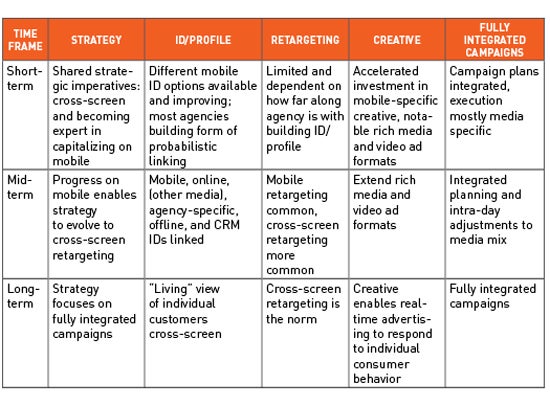
A short-term, mid-term, and long-term scenario is described below and outlines the different evolutionary paths. This table is an attempt to get beyond the strategic intent and into the practical building blocks that take time and effort.
Now What?
There is a difference between strategy, marketing and practical realities. This is not reducing the real value of strategy and marketing to set direction; both are essential to inspire, clarify, organize and plan. It’s just that sometimes the practical realities don’t get the headlines or press.
As we look forward two to five years from now, the digital advertising environment will be dominated by mobile, driven by brand spending, absent a cookie (successfully substituted by proprietary linking and retargeting solutions) and seeking to recognize and adapt to consumer signals in real time and cross-screen.
The key job now, and in the next two to three years, is to lay that groundwork: Master mobile, leverage mobile’s emerging data model that establishes a linking and retargeting environment independent of the cookie and invest in the creative to convert it from a liability to an accelerant — not at the expense of fully integrated campaigns, but as a necessary prerequisite to cross-screen success.
You can follow Ernie Cormier (@ecormier), Nexage (@Nexage) and AdExchanger (@adexchanger) on Twitter.






