“Data-Driven Thinking” is written by members of the media community and contains fresh ideas on the digital revolution in media.
Today’s column is written by Melissa Coleman, Director of Client Success, Americas, at Adjust.
Apple’s latest update that its IDFA restrictions are set to kick in on April 26 means that you’ll soon learn whether your user opt-in strategy actually works.
Opt-in audiences are highly coveted — and, of course, elusive. Intuitively, marketers know that engaged and valuable audiences are built from people who embrace marketing communications. And obtaining consent from mobile app users will be more important than ever. Gaining this kind of access to user data starts with asking your users to opt-in in a way that builds trust and delivers an on-brand customer experience.
Remember, app users will experience a slew of AppTrackingTransparency (ATT) opt-in requests, which may feel overwhelming. But ultimately, their choice to opt-in is putting them in charge of the privacy of their data — and this is a step in the right direction. Being part of a conversation with users about their privacy, and offering them a transparent opt-in experience, are essential to strengthening trust in your brand.

The deprecation of the IDFA does not have to mean the death of data-driven marketing. With ATT, advertisers can continue to receive deterministic attribution data and carry on with segmentation and retargeting efforts — they just need to focus on building customer relationships based on trust.
Pre-permission prompts result in higher consent rates.
In the past year, R&D teams at mobile advertising companies have developed best practices for securing user opt-ins via the AppTrackingTransparency (ATT) framework — particularly experimenting with pre-permission prompt messaging and choosing when to launch the request in their app. Although opt-in rates have varied across verticals, apps from multiple industries have achieved results in the 20% to 40% range. Finance apps perform particularly well, and that is likely due to the implicit trust consumers associate with their banking and payment providers.
So, how do brands present tracking permission requests in a way that doesn’t scare off users and earns the same implicit trust as banking apps?
The answer lies in a combination of context and trust: opt-in research across verticals shows that pre-permission prompts are successful in raising consent rates. Rather than showing users a privacy notice out of context, you instead tailor your messaging to give the ATT pop-up a frame of reference.
Three variables have consistently returned higher results in asking for consent.
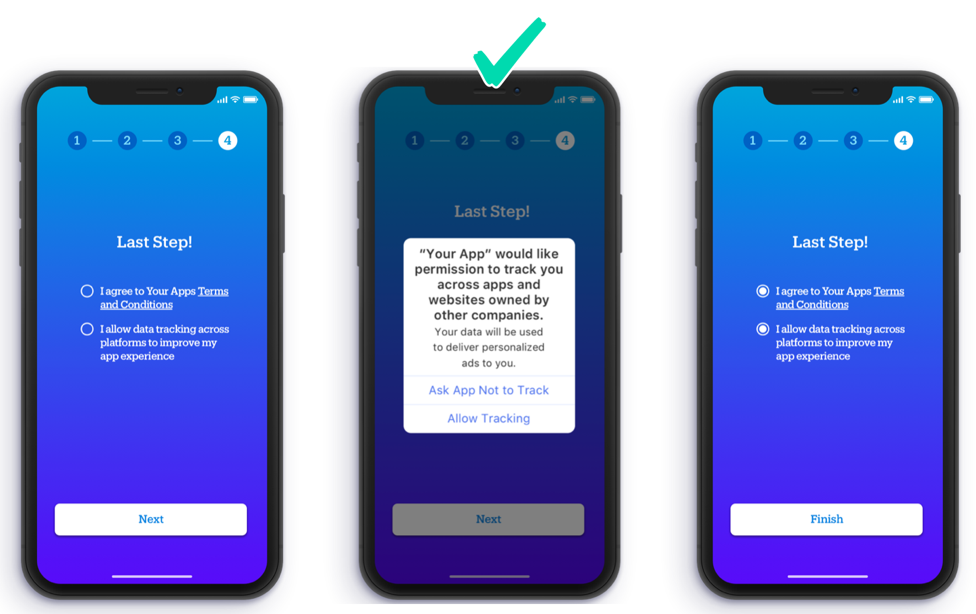
- Location. There are some highly successful designs that manage to seamlessly inform users about the tracking request, serve the ATT pop-up, and close up the onboarding process. This strategy has performed well across every vertical, but a lifestyle app testing it saw an ATT opt-in rate of 65%. It’s important to note, however, that this approach can only be fully realized with new users.In the example pictured, the privacy notices are thematically grouped. Irrespective of how the user responds to the options on the native app screen, they will still be shown the ATT pop-up. By keeping the Apple notice separate, you stay within their guidelines, but by queuing the messaging, you are also building users’ sense of trust.
- Size. Full-screen pre-permission prompts have consistently outperformed modal pop-ups or partial screen messages. And this likely is because they can be better branded, customized, and more seamlessly integrated into the user journey. This ultimately makes them feel more trustworthy.As an example, an ecommerce app testing its pre-permission prompts found that a small modal pop-up on the bottom half of their screen received less than a 30% opt-in — and that was just for the pre-permission screen. This is more than half of what we’d typically expect from a pre-prompt, around 70%.

- Button placement and copy. When it comes to the placement and design of call-to-action buttons, this is low-hanging fruit. First, you have the option to offer a single button reading something like “Next”. This works really well for prompts that take a more informative approach.Alternatively, you can give the user options. In this scenario, it’s recommended not to mirror Apple’s own button wording on your pre-prompt. In terms of placement, the best results come from stacking them horizontally rather than vertically. In fact, a gaming app testing this approach gained a 5% increase in opt-in simply by switching its button positions.

The concept of trust is not new to marketers, as trusted companies tend to see better long-term retention and growth. But you need to be able to quantify this trust, which is where asking for consent plays a big role. When users understand why you need to track their data and what purpose it will be used for — especially if it’s to enable features they want to access, such as a more relevant ad experience or an improved product flow — they are more likely to give their consent. One-size-fits-all approaches to data sharing are less likely to win over users.
Better results from invested users
A big audience is good, but an engaged audience is better. Marketers should focus on this sentiment and realize that even a small audience that has opted into your tracking is incredibly valuable. From initial testing, advertisers see that even with just a 10% opt-in rate, they can expect results with a high degree of accuracy. And with that more accurate data set, they can feel confident in their data-driven decision-making — ensuring continued growth.
This point may be obvious to some, but the best thing about consented data is that it provides deterministic, user-level attribution data points you’re used to. Beyond that, we have been designing models during the last few months evaluating what data streams will be available post iOS 14 and how we can maintain business as usual or as close to it as possible. Of course, the reality is that the models are only as effective as the data you feed them. Consented attribution data points are the best data that you could feed into any sort of attribution model because they are one-to-one data points.
Ultimately, higher opt-in rates will improve understanding of KPIs, allowing you to optimize more efficiently, leveraging the tools at your disposal to build better, more personalized experiences. More importantly, being transparent with your users will build the trust and lasting loyalty every marketer craves.
Follow Adjust (@adjustcom) and AdExchanger (@adexchanger) on Twitter.