
 “Data-Driven Thinking” is written by members of the media community and contains fresh ideas on the digital revolution in media.
Today’s column is written by Paul Steketee, head of paid social and emerging media capabilities at Merkle.
The growth rate of mobile is kind of like China’s economy: impossible to really track.
The rapid takeover of mobile devices as our primary access points to the Internet requires an equally quick change in digital advertising. As one of my colleagues eloquently put it, the year of mobile is finally here, but it’s not what we expected. In fact, the mobile ad landscape has changed incredibly rapidly in just the past six months.
What did we expect? The industry would adopt disruptive ads that display on mobile devices.
Why has this not coming to fruition? There is simply no real estate to fit a standard display ad on the mobile screen.

Why is this actually a good thing? Digital advertising in mobile can take on a chameleon-like ability to be more blended within the consumer’s mobile experience. Native ads are shape-shifters fueled by content.
A good mobile ad includes content that accomplishes a fundamental advertising objective: It gets noticed. But not in a way that offsets a positive audience experience and results in a reduction of receptivity to the message.
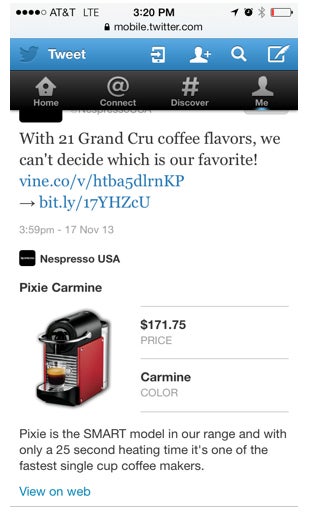
Examples of native ads that benefit both audience and advertiser can be found in mobile “in-stream” or “news feed” placements. In the below example, the advertiser’s message is a prominent, contextual placement.
A good mobile ad can appear in a relevant context based on more precise criteria than ever. Relevancy to content the audience is interested in, recency of interactions with keywords in social content and relationship to other people in your network are a few ways I’ve found ads in my news feed to be timely and effective.
Native mobile news feed formats afford the opportunity to literally take over an audience’s full mobile screen and capture their attention, yet they do so in a much less intrusive manner than a forced interstitial takeover unit, for example. The takeover happens either post audience engagement, which indicates the audiences’ desire for more, or the mobile screen takeover displays right in the native mobile news feed, which can be scrolled past even more easily than changing a TV channel or skipping a commercial.
That said, there is no shortage of impact available with good news feed advertising. I call it “powning” the second screen. There are few formats in all advertising media that demand as much engagement and attention as a full-screen news feed ad, be it one the audience scrolls by (still generating more awareness than a skipped commercial) or one that generates audience engagement (thus dominating the share of mind and the share of screen). The example below is what displays after clicking a tweet in the news feed timeline. I indicated my interest and the advertiser now has my undivided attention.
An example of the opposite approach, and one I do not recommend for mobile platforms, is the mobile pop-up. Please, ask yourself, did you ever like desktop pop-ups? Should we expect our audience’s thumbs to be as precise as a mouse pointer on a 1024×768 screen? Certainly not with my fat finger.
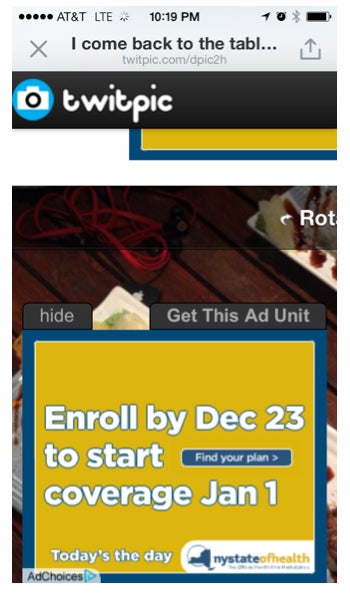
The image above is from a service that provides links to images. Except when you click to view the image, it is entirely covered by an advertising message that you (annoyingly) have to close in order to see the image. Not the best mindset to put the audience in when accomplishing goal No. 1 of getting seen. I was simply trying to look at someone’s beautiful and important #foodporn picture, but this ad thwarted me. Time is always of the essence with audiences – especially in mobile.
(In this example, I should note I have nothing against health care or health-care advertising. I only take issue with the format.)
So, native shall rule the small screen. And let it be contextual, targeted and relevant. As multiple publishers and platforms adopt the scrolling news feed approach, we have the opportunity to advertise without disrupting, and this allows our messages to be seen in a positive light – provided the content adds value to the audience.
Follow Paul Steketee (@steketee), Merkle (@MerkleCRM)) and AdExchanger (@adexchanger) on Twitter.









