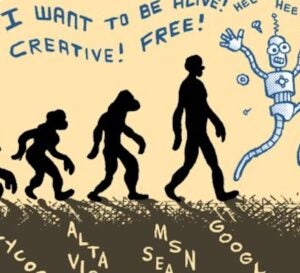

Inherent bias is embedded in all AI training data. This bias is perpetuated by nondiverse teams determining who gets access to it and how it’s used. That bias is then accelerated by the competitive nature of high-power investors whose primary goals are dispersing software and tools to generate outputs for clients and revenue for themselves.
While you may have been making strides in diversity, equity and inclusion (DEI), your AI journey has the power to derail and undermine your actions. Data biases threaten the foundation of an inclusive AI ecosystem and lead to an all too familiar dynamic where a lack of diverse perspectives and expertise leads to upholding old ways of thinking.
Generative AI is undoubtedly one of the biggest and fastest-growing revolutions the marketing industry has seen since social media. But its emergence presents challenges. Courage is crucial to build a different system – one that’s centered on the considerations of diversity and inclusion.

Where does change start?
Creating an inclusive environment with representation that mimics a multifarious society and enables participation, access, knowledge and support for diverse generative AI users is essential.
From executives to entry level and everyone in between, a diversity of users can prevent the continuation of inequitable and noninclusive practices that are disruptive to boosting innovation.
But it’s not enough to simply tap diverse communities and members to extract insights only when needed. If inclusion is prioritized when building a generative AI ecosystem, centering diverse voices is necessary to redesign and overwrite known training data bias and support the continuous evolution of generative AI outputs that accurately portray society.
I’m representative – now what?
Generative AI has the potential to disproportionately affect the workforce, especially for marginalized, disenfranchised and underrepresented groups.
Enabling participation through equitable access and commitments to upskill while investing in the broadest range of generative AI users possible can rectify this. Every user should be considered critical to developing inclusivity within generative AI and should be supported as such.
Through expanded training, widespread access and variegated resources, we can ensure current and future generations of diverse AI users have the collective knowledge and expertise to contribute responsible, impactful and nuanced builds. This will allow for inclusive adjustments within the technological infrastructure over time.
Paired with human intervention, these inclusive adjustments will help ameliorate existing inequalities that these systems and tools could escalate for marginalized and underrepresented groups. This strategy can help move society toward the greater goal of creating inclusive systems.
Staying the course
While it is vital to consider the impact of DEI when activating generative AI solutions, it is even more vital to align on policies and processes that ensure these considerations are second nature – and not optional. Generative AI policies, including ethical usage, are important to maintain momentum toward the production of content and outputs that both accurately portray society and minimize negative societal impacts.
Though they may not be fool-proof and require review and revision, they can act as a moral compass for companies laying the groundwork for what is safe, equitable and ethical.
The marketing industry has a responsibility to use the influence it has to bolster the advancement of society. Having the courage to step out of a repetitive cycle, where systems are built without considerations of diversity and inclusion, will demonstrate what it looks like to intentionally shift from autopilot and instead advance modern society through this technological revolution.
The question remains: Will we let history repeat itself and cause continual harm to marginalized and disenfranchised communities, now at an exponential rate through technology? Or will we finally take action to minimize the disparities they face to advance toward an inclusive society?
After all, hindsight is 20/20, yet history has a habit of repeating itself.
“Data-Driven Thinking” is written by members of the media community and contains fresh ideas on the digital revolution in media.
Follow OLIVER, InKroud and AdExchanger on LinkedIn.