 “Data-Driven Thinking” is written by members of the media community and contains fresh ideas on the digital revolution in media.
Today’s column is written by Bob Gilbreath, co-founder and president of Ahalogy.
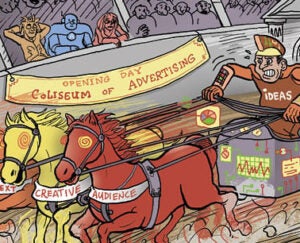
Back in the golden years of advertising, the creative agency was king and media folks were second-class citizens. A typical agency meeting was spent debating the latest creative boards before the media lead stepped up during the last five minutes to show us which demos we would buy against.
But a subtle shift since then has started to accelerate and thanks to new technology and consumer control, the creation – and cost – of creative will never be the same.
In those old days, we needed creative for five things: TV, print, packaging, in-store displays and Sunday coupons. Now, the fragmentation of consumer attention pressures marketers to have a presence on 50 media channels, from multiple social media and sponsorships to events. Each activity requires its own creative execution, requiring exponential time and money demands.

We’re now starting to learn that you need specific creative for each tactic, as well as multiple pieces of creative to scale success. Social media in particular is a content-hungry beast. Facebook and Twitter, for instance, demand real-time responses to the day’s events.
Smart media channels recognize that creative is the biggest barrier to growing media sales, so they are changing the game by lowering the bar to content creation. Facebook now provides free Shutterstock images to anyone buying advertisements on its platform, and will even give multiple free images for every ad unit, automatically testing them to shift dollars to what is working best.
Sure, they are stock images for now, but what’s to stop Facebook and other fast-growing, high-margin tech players from offering even higher-quality creative? Spend a million or more dollars and they’ll do a shoot for you. Spend tens of millions of dollars and they’ll give you a creative team for free. Marketers love the speed and simplicity of this model, as well as the fact that creative costs look like they are a free bonus rather than a non-working line item.
Creative Is Becoming Democratized
As marketers struggle to penetrate more media channels with the same or lower budget each year, they are increasingly drawn to the siren song of semi-professional and crowdsourced creative. In new areas they are more willing to try a user-generated contest or work with a group of skilled freelancers.
Venture capitalists are adding fuel to the fire by investing in platforms that better organize the growing legion of long-tail creatives. In social media, for example, fast-growing companies are helping brand managers create their own Instagram posts and route them for all required approvals within seconds.
We are witnessing a version of the Innovator’s Dilemma. As markets get mature, the leading players consolidate and get more focused on incremental innovation of high-margin activities. Meanwhile, upstarts begin picking off market share with a lower-cost solution that is barely good enough, but over time, the little guys get better and the big players are unable to adjust.
We’re seeing it play out before our eyes in advertising. We’re down to a handful of big agency holding companies that are focused on a handful of enormous marketers. They continue to play an older business model of paying a premium on dedicated agency personnel. Meanwhile, clients are buying “good enough” creative for smaller channels, such as user-generated viral videos for YouTube.
It’s too small for the big players to fuss over today. But the latter channels are earning customer attention at scale, and the speed and cost benefits are unbeatable.
The Wisdom Of Data Is Winning Out
Back in the days when we spent 80% of our quarterly marketing budget on a single 30-second ad, we also spent enormous time and money trying to make it perfect. I recall countless, second-by-second edits and well over $100,000 in months of market research alone. Those days are long gone.
Smart marketers have learned their Socrates: “He who is wise admits he knows nothing.” In other words, it’s just too hard to guess the market and assume that one “perfect” ad will win all the business. Instead, they are creating multiple pieces of creative and letting real-time analysis with actual consumers decide what is best.
More swings of the bat offers more chances to hit one out of the park, and advanced marketing algorithms are helping to make every swing a little more powerful. The need for more swings, however, leads back to the points above: more creative, speed and willingness to try game-changing models. Intense economic and competitive pressure is driving change at an even faster rate.
Don’t feel too bad for the big agency companies, despite the growing breakdown in traditional AOR relationships, with marketers like Frito-Lay, Mondelez and Best Buy announcing a move to project-by-project relationships. Most have been investing in startup ideas, programmatic media tools and new business models for some time. Their core competency lies in building trusted client relationships, and those clients would rather keep working with them, as long as they keep up with the changes that are afoot.
We marketers are living in interesting times indeed.
Follow Bob Gilbreath (@mktgwithmeaning) and AdExchanger (@adexchanger) on Twitter.