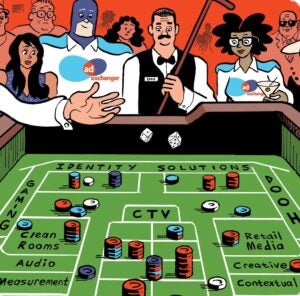
The media industry has a junk food problem.
Marketers and their agency and DSP partners have grown so focused on vanity media metrics, such as clickthrough rate (CTR), cost-per-click (CPC) and video watches, that roughly half of all ad supply is made-for-advertising (MFA) inventory – sites and pages that use clickbait headlines and filler content to generate traffic and cluttered layouts with awful user experiences to cram more display and video ads onto the page.
A recent Jounce report concludes that MFA inventory presents “a trap” for marketers, luring them with inflated vanity metrics but ultimately delivering “no impact on consumer behavior.” Marketers can’t afford to keep wasting their marketing spend on MFA junk food. They need to shift toward “clean” ad inventory that delivers high-quality impressions. Some companies, like Sharethrough, are starting to offer options to curate their inventory to remove MFA sites.


Made by market demand
In general, when DSPs don’t receive real-time feedback on consumer behavior, they optimize to media KPIs like CTR, video watches, mouse hover rate, etc.
These KPIs were once related to an ad’s impact on consumer behavior, but they quickly became standard for measuring campaign success. And it didn’t take long for a whole industry to pop up to manufacture those impressions.
We’ve all experienced these kinds of sites: typically never-ending “listicles,” slideshows and other fluffy filler content that’s surrounded and overwhelmed by what the Jounce report describes as “high-density auto-refreshing ads” that “create a user-hostile experience.”
Jounce’s research confirms that these sites don’t work, demonstrating that MFA inventory delivers a “large conversion deficit.” It’s not just that MFA inventory delivers fewer conversions than expected, but MFA inventory underperforms in a way that Jounce concludes “has zero impact on consumer behavior.”
At best, MFA inventory is wasted spending. And in many cases, the audience’s negative feelings generated by the chaotic and obnoxious user experience transfer to the advertiser brand – damaging brand perception.
But the reality is that marketers are hooked. Media KPIs are still used to define campaign goals, which pushes agencies and DSPs toward MFA inventory. Much like the proliferation of junk food in our world, marketers’ hunger for higher media KPIs drives the insidious propagation of the MFA ecosystem.
Supply-side complexity
In early 2022, Jounce reported that the average publisher monetizes through more than 17 sell-side technology integrations, which grew to 28 by the end of 2022. Moreover, resold supply paths now account for more than a third of display auctions and more than half of video auctions. This decreases buy-side transparency of supply paths, making it much riskier to rely on site lists.
MFA sellers are getting wise to domain blocking, and they’re finding new ways to obfuscate the true nature of their low-quality inventory. For example, many use subdomain renting – paying a fee to essentially take over a subdomain of a more reputable publisher site. Marketers and agencies are growing increasingly frustrated with the inability to avoid low-quality inventory.
Putting the pressure on
Just as market forces created the MFA junk food, market forces are now starting to push back against it in the following ways:
- Marketers are more serious about supply-path optimization (SPO).
In response to growing complexity, marketers are increasingly adopting – and rapidly maturing – supply-path optimization (SPO) strategies. Agencies are also going beyond paying lip service, including proactively blocking low-quality supply and shortening approved publisher lists.
- Marketers prioritize sustainable ad supply chains.
Tactics like subdomain renting and supply reselling add more and more layers to the already-complex digital ad ecosystem. More layers mean more servers spinning to support each intermediary player. And while MFA inventory fails to deliver marketing value, all those additional servers produce excess carbon. As more companies make ESG a top priority, marketers are recognizing that a “clean” supply is also a low-carbon supply.
“Clean” inventory supply grows
It’s tough for marketers to wean off the junk food. There’s no DSP checkbox that says, “Avoid MFA sites” – yet.
Manually curating your own site list is incredibly time-consuming, and site lists are problematic for reasons already discussed. But more “clean” exchanges are emerging, some of which create a safe place for marketers to buy high-quality inventory without worrying about lower-quality impressions showing up. Sharethrough, for example, uses Jounce data to curate all PMP deals toward high-quality supply.
It’s like changing where you shop, seeking out a curated health food store where there’s no junk food to tempt you.
Clean exchanges also help marketers spruce up their ad inventory. But a more fundamental shift needs to happen: Marketing teams need to stop paying attention to vanity metrics.
Agencies and DSPs need the right incentives. Campaign goals around clickthrough or CPC lead to MFA inventory. Marketers shouldn’t measure success by what happens on their sites; it’s what happens beyond the site visit that really counts.
Supporting quality publishers
It’s hard for marketers to rip off the Band-Aid and completely ditch MFAs.
Metrics are going to drop by a lot, but remember these metrics weren’t driving business outcomes anyway. Once the right things are measured, marketers can quantify the downstream results and business value in terms that matter: actual sales conversions, purchases, revenue and marketing ROI.
Junk food in the media world is a lot like the public health perspective on real junk food. It’s not just a negative cost to the individual; the negative externalities spread across the digital ad ecosystem: We feed the beast of low-quality inventory while starving premium publishers of revenue.
Collectively weaning ourselves off junk food means we can start feeding more revenue to premium publishers, the kind of content creators we want to support as advertisers and as a responsible society.
For more articles featuring Curt Larson, click here.