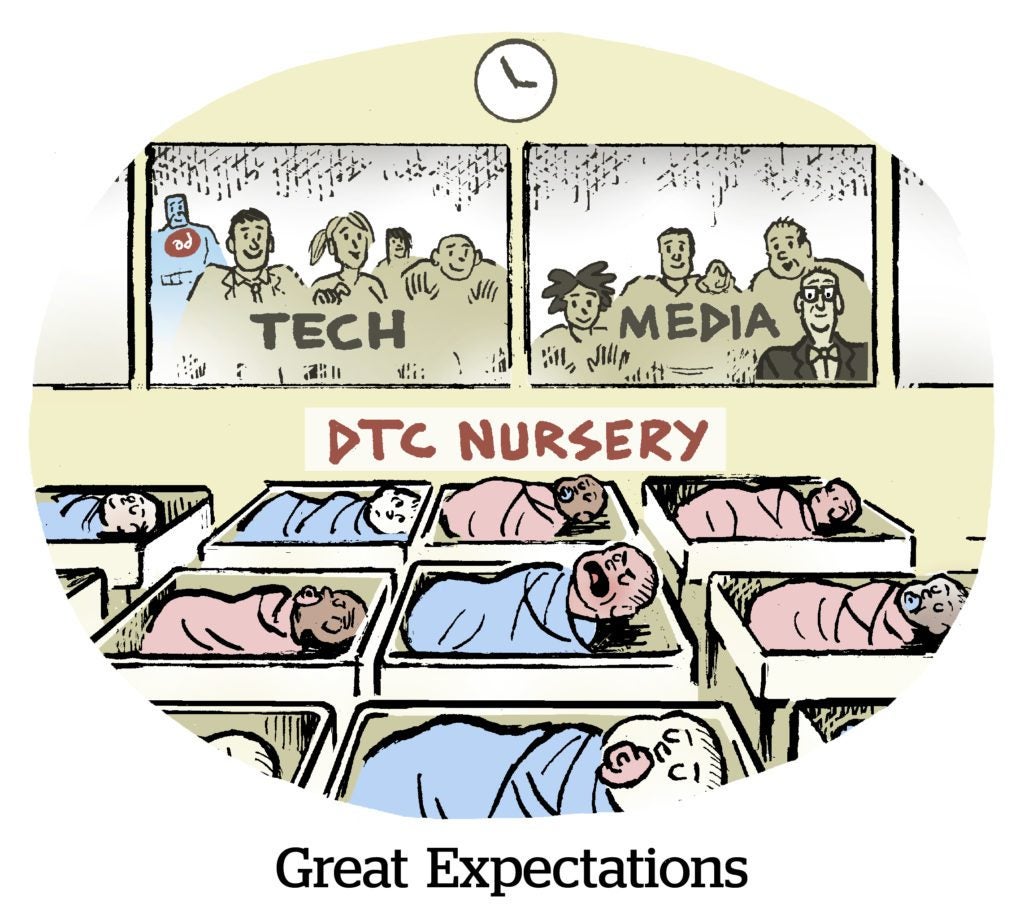
The direct-to-consumer cookware company HexClad was founded in 2016, and celebrity chef Gordon Ramsay joined as investor-ambassador in 2021.
HexClad surfed a huge wave of new business in 2020 and 2021, as many people began cooking more at home.
By 2023, the company had matured to the point that execs decided “we really need to own our own creative destiny,” HexClad Head of Content Matt Duckor told AdExchanger. They brought on Duckor, the first internal creative hire, with a mandate to in-house the capabilities that previously had been assigned to a “patchwork of various agencies.”
Now, HexClad has a 5,000-square-foot studio in Los Angeles and does almost all of its own production and design, he said, including editorial, copywriting, social content, packaging and design.

Get creative
An important part of developing the in-house creative group at HexClad is to prove the return on investment, according to Duckor.
Some creatives are for bottom-of-the-funnel ad units, and thus meant to convert. Other spots up the funnel aren’t meant to convert directly, but should still be contributing to that conversion in a demonstrable way, he said.
More and more, good creative is seen as driving performance.
“There’s hard data to reflect the value” of interesting out-of-home campaigns or streaming TV, nowadays, he said, as opposed to “vanity channels” where the brand just hopes for good results.
Also, creative investments can lead to important brand opportunities that bring the down-funnel metrics that performance or growth marketers want to see – like incremental sales. HexClad recently shot a commercial with Gordon Ramsay and Dr. Dre to promote a new cocktail shaker that’s a collaboration between the cookware manufacturer and Dre’s Still G.I.N booze brand.
The shaker is the first such collaborative product for HexClad, Duckor said.
“It’s an incredible opportunity to meet like a completely new audience in a different category,” he added. “We’re looking at, of the people who are converting, what percentage are net-new customers to the brand? And what’s the lifetime value of those new customers acquired through a partnership like this?”
HexClad also released a documentary called “Open to Close” this month that follows Ramsay and three other famous chefs for a day in their restaurants.
The big online platforms themselves have helped validate the value of creative investments. A few years ago, Meta began pushing the line that “creative is the new targeting,” Duckor said. The idea being that rather than having humans optimize campaigns based on demographic or behavioral targeting, advertisers upload creative that itself informs the Meta ad platform algo of who to target.
The AI revolution
It is also not a coincidence that HexClad decided to invest heavily in its own creative at about the exact moment that generative AI content became broadly accessible in 2023.
AI tech is built deeply into every creative suite out there at this point, Duckor said. Adobe Photoshop and After Effects incorporate AI, for instance, as do all the ad platforms. And the HexClad team has been using Google Gemini’s latest Nano Banana Pro model for imagery.
But these creative products are still “in their infancy,” he said, let alone ready for end-to-end content production.
AI is great for doing fantastical things, he said, like a whale jumping out of a tank in the middle of Fifth Ave in New York City. But ask AI services to faithfully recreate particular products over and over, and they cannot. The issue is acute for HexClad, specifically. Its pans have a distinct hexagonal design on the cooking surface, which AI tools struggle to reproduce.
The big platforms have their own visions for generative AI creative across their networks, he said. But, if anything, that’s upped the status of actual in-house creative.
“We have to try to stand out and make our ads look and feel different,” Duckor said. The algo encourages every brand to copy the top-performing ads and ad types on the platform at any given moment. And each platform’s built-in generative AI creative is “doing that to the Nth degree.”
Already, Meta ad accounts are full of hundreds if not thousands of similar-looking ads from whole categories of brands. This is likely driving up fatigue among consumers, Duckor said, and thus increasing customer acquisition costs.
“And once everyone starts using those [generative AI creative] tools,” he added, “I think you’re going to see an even worse version of what people’s Meta ad libraries look like right now.”