 Mike Schott joined Volta, which makes electric car charging stations, almost six years ago to build out the company’s nascent advertising business.
That makes Volta early to the everything-is-an-ad platform trend. It’s the only electric car charging station company with an adjacent ad business.
Companies that have access to O&O inventory and at least some claim on consumer attention are realizing that they also have a potentially compelling pitch to marketers, which is why we’re seeing ad platform launches from the unlikely likes of Ulta, Uber and practically every retail chain out there.
Even back in 2016, Schott, a longtime EV owner himself with a background in ad tech – he’s the former VP of sales for DSP Viant – had the sense that “an advertising business would be a strong differentiator,” he said.

But it’s taken time for Volta to build out its stations and thus its network of inventory.
Volta has grown from 125 charging stations in 2016 to more than 2,500 stations today. When Volta started, it only offered static display. Now, each charging station carries two digital screens and has 100% programmatically available inventory.
Even with the sell side of its house in order, however, Volta had to wait for the buy side to mature and settle on new standards of accountability before its ad platform opportunity could ripen.
Although Volta Media, as Volta’s ads division is called, doesn’t disclose its ad revenue, it all falls into the digital out-of-home (DOOH) category since it’s fully programmatic.
“Programmatic is a big help because the biggest pushback we would get early on – and still do get – is on scale,” Schott said.
Volta may have thousands of screens across the country, but the biggest DOOH media companies have thousands of screens in a single large city.
“What programmatic allows buyers to do is seamlessly incorporate Volta into the story of reaching the right audience, without Volta bearing the burden of carrying scale,” he said.
To date, Volta’s ads business has mainly focused on the obvious endemic brands, such as auto companies, any company that touches on electric vehicles or brands with a message about sustainability.
Makes sense. Volta is an EV charging station company, after all. But to reach its next growth phase, Volta Media needs to branch out into new categories.
Some savvy performance marketers, like Uber and Postmates, have seen success with Volta, said Brittany Eckett, director of investments for WPP-owned OOH agency Kinetic.
Electric vehicle or sustainability brands pick up a “halo” effect from associating themselves with EV charging station inventory, she said, but more advanced brands with their own apps see DOOH ads as a performance channel. A QR code that pops up on a screen while someone is charging their car, for instance, could be used to immediately zip that person to an app download page.
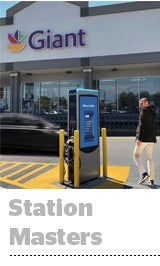
Another exciting creative opportunity comes from the food, beverage and household brands carried in grocers or gas stations, Eckett said. Many Volta charging stations are located right outside of stores. The company has partnerships with numerous property owners, including Kohl’s, Stop & Shop and Giant Foods.
A CPG brand could use QR codes or email-based offers that provide a coupon for products carried in a nearby location.
Last month, Volta introduced its first retail media product, taking a step into CPG, grocery and convenience store brand advertising. Volta can now offer inventory that appears only on screens in specific parking lots or in proximity of other real estate owned by grocers, pharmacies and related stores. Ads can also be geotargeted to run on Volta screens near stores known to carry a particular product.
“I do believe CPG will be on par with automotive in terms of endemic categories,” Schott said.
With enough scale around specific stores, Volta can work with retail data companies like Catalina or Quotient to attribute incremental sales to DOOH campaigns.
“The way to win in CPG is to measure high exposure to purchases and incremental sales,” he said.
Earlier this week, Volta announced its first retail attribution partnership with Catalina.
But although Volta is honing its pitch to CPG brands, it also has a compelling offer for retailer clients. Those relationships are critical because stores and real estate owners are the ones that agree to set up Volta stations in their parking lots.
Volta now offers its retailer partners a portion of its inventory in order to extend the reach of a store’s own programmatic platform – now that most of the major grocery chains operate their own ad platform, too.
“That is a conversation we have at the tip of our spear,” Schott said. “It’s not just the EV conversation if we’re contributing a valuable, differentiated screen to the retail media network machine that’s already spinning on their end.”