

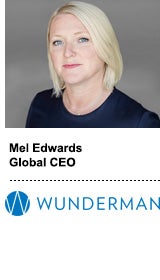
Mel Edwards, the newly minted global CEO of Wunderman Thompson, has a huge job ahead of her.
When the agency officially launches this year, it will have 20,000 employees in 90 markets across 200 global offices, and eventually, Edwards wants everyone in each market working together.
“We need a little more time because of the size of our business,” she said. “Things like getting everyone on the same email is not as simple as maybe I’d hoped.”
The goal behind the Wunderman and J. Walter Thompson merger, which brought together a digital and CRM agency with one of the world’s oldest creative agencies in November 2018, is to provide more integrated and streamlined services for clients. JWT will soak up data and technology skills from Wunderman, while Wunderman gains expertise in brand advertising.
But it’s not just about bringing together the best of both worlds from both agencies.
“This is about creating a new company for now,” Edwards said. “What are other successful businesses doing that we can mirror and understand? I’m really keen we do things differently.”
She spoke with AdExchanger.

AdExchanger: What do you envision doing differently at Wunderman Thompson?
MEL EDWARDS: We can combine commerce with brand storytelling. That’s building big dot coms, like Net-a-Porter, and also working with clients on commerce strategies on- and off-platform.
We have a huge amount of data here. We can see the opportunity to become more agile with data, hold more and use it better. But the thing that’s going to make us stand out is how we fuse that with creativity. Bringing JWT into the mix, it just becomes a powerhouse.
What’s the biggest cultural challenge in bringing together a creative and digital agency?
There are going to be some sensitive and difficult conversations along the way. At a market level, we need to look at where the center of gravity is and what our needs are to work out how brands and people come together.
I’m really conscious that we communicate. When people don’t know what’s going on, they think something is happening. There’s a lot of nervousness that we’re doing this as a cost-cutting exercise. It’s not. It’s very much about how we broaden and bring together our capabilities, because our clients want simplicity. They want to work with one team rather than loads of different companies.
How easy will it be for clients to navigate a 20,000-person agency?
Some of our clients like scale. It gives them peace of mind that we’re a global network that can work with them across markets. Other clients want a flexible, small team that can work on-site. You have to flex dependent on what their business challenges are.
Will JWT be more focused on digital or traditional creative under Wunderman?
Every time I’ve met an advertising agency over the last few years, the only work I ever see is digital. I’ve pitched in the past with other advertising agencies and it’s very much digital work.
How will that resonate culturally?
At JWT, there’s still a lot of TV. That will continue. The Wunderman team are super excited about that because it’s something they’ve never done.
What’s been one of the most surprisingly difficult things to navigate about the merger?
Sorting out lease holds of every single agency. The length of the lease, the cost implications of moving out, getting us all into one building are not quick to fix.
In New York, Wunderman is moving into the JWT offices as our global headquarters because our lease was up in Columbus Circle. But in other markets, the lease holds are through another five years on either side. What’s the financial impact? That comes with complexity.
What’s it been like taking over Mark Read’s role?
In a way, it would be easier for me if he did a shit job. But that’s a harder job to turn around an organization that’s struggling.
I got to a place in my career where I know what I’m good at. Mark is very different from me, but we align. He comes about it in a different way. I’ve learned a lot from Mark. But when I took the role, I was very conscious that I’m not Mark, and I need to bring the strength of what I do in the business. And one of the key things for me is making our business come alive with creative.
This interview has been edited and condensed.







