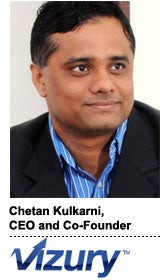
 With his company’s roots in lead generation, Vizury CEO Chetan Kulkarni is unequivocal about the importance of first-party data and the value it can create for advertisers.
But, before one can begin using first-party data effectively, Kulkarni suggests defining it.
“Let’s say we’re talking about a transaction – for first-party data, you need to ‘map’ backwards from the transaction in terms of what sort of data is being used to predict the transaction, not influence the transaction. When you do, you see a few things. First, recency and depth of the visit to the website. Second, the transaction history that the user carries with the advertiser. For example, a user has a propensity to engage, explore, and buy a particular product or a particular brand.
“The third thing you see is the propensity to respond to ads – this is a great indicator of whether the person is going to transact. So, when I say first-party data or data in general, I mean those three signals.”
India-based Vizury was co-founded in 2008 by Kulkarni, COO Gourav Chindlur and CTO Vikram Nayak. The company has raised $11 million in venture capital from investors such as Nokia Growth Partners and is approaching 200 employees.
With headcount expected to double in the next year, and APAC revenue continuing to drive results, Kulkarni positions Vizury as a digital CRM company rather than an agency or tech company.
“When you think of the traditional off-line world of CRM, it performs two functions,” he said. “One is to capture data from interactions in a showroom or on a phone call and so on. The second function is to help advertisers power their marketing conversation in a one-to-one way and across various channels. A text message or a phone call or direct mail may be a channel. This is what the traditional CRM systems do, and the end marketing goal is to maximize lifetime value. That’s the holy grail for any CRM system.”

Vizury is applying a similar philosophy to the digital world, added Kulkarni, by helping advertisers relate and make sense of data across digital channels such as email, mobile apps or websites and then “power” one-to-one conversations across those same digital channels.
AdExchanger asked Kulkarni more about Vizury – including where it fits in the service layer.
AdExchanger: Do you go through agencies in order to work with clients and their first-party data?
CHETAN KULKARNI: We believe agencies are enablers in terms of helping advertisers find the best solutions. But, in terms of the way Vizury approaches the market, we have a direct line of sight — and contract — with the advertisers. We have a dedicated service team that is working on multiple solutions for the client that helps them manage lifetime value.
What is Vizury’s target market?
We slice it in two dimensions. First, vertically. We are strong in travel, ecommerce and classifieds. The other dimension goes back to the CRM philosophy. … There is a do-it-yourself sort of CRM, but our approach is more hands-on. We prefer to work with larger clients in the geography we operate in.
How does the ad-exchange model apply to your business today?
When I look at the channels for our business right now as it relates to exchanges, it is mostly display. We have robust RTB integrations with Google, AppNexus, Facebook, the Rubicon Project and all the usual suspects. In the end, the ad-exchange model helps our advertisers reach their users at a point in time.
What milestones would you like to achieve in the next year or two?
We have traction in many markets, but moving toward a market leadership position in these markets would be one milestone. The second has to do with rolling out more products and services we’ve been testing — but can’t talk about quite yet.
What about offline? And either using offline data to inform digital campaigns, or using your digital CRM capabilities to affect offline conversion?
In the region [where] we’re concentrating, there is no Acxiom. But we are very bullish that that sort of opportunity is becoming real in the market. Nevertheless, the ecosystem does not exist in terms of identifying sources of data, and the ongoing process of getting the data online. Offline does form an important part of our very long-term plan, but in the near term, we don’t see anything to act on. Our clients don’t come to us about offline; it’s been mostly about digital.
Follow Vizury (@vizury1to1) and AdExchanger (@adexchanger) on Twitter.