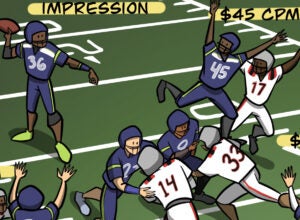
As holding companies distribute programmatic knowledge to their operating agencies, trading desks are repositioning to stay relevant to clients.
Xaxis, GroupM’s trading desk that pioneered the model of selling media to clients at a mark-up on a guaranteed CPM, will now buy for clients on guaranteed metrics that impact business performance, such as viewability and incrementality.
“Programmatic should deliver a lot of value to brands, but as an industry we’ve made it very complex and, if anything, less accountable,” said Nicolas Bidon, global president at Xaxis. “The metrics we use, whether it’s CPM or CPC, are really old.”
To deliver on business outcomes rather than click- and view-based metrics, Xaxis is building custom algorithms for clients through its machine learning platform, Copilot.
For a hotel booking platform, for example, Xaxis is optimizing its spend toward guaranteed incremental visitors. For an auto manufacturer, it’s delivering on an overarching success metric that weights actions like brochure downloads and test drive sign-ups into an overall score.
Xaxis wants to eventually rent these algorithms to clients who don’t want to work through the trading desk to buy their media.
“[The client] would have full transparency of what media they buy, where it runs and what was the clearing price,” Bidon said. “It’s quite the departure from our regular business model. One-size-fits-all doesn’t always work.”
Xaxis, which works with 3,300 brands in 47 markets, is still producing more than $1 billion in revenue annually. The company has 1,800 employees globally.
Bidon spoke with AdExchanger.

AdExchanger: You guys were always talking about performance. What’s different?
NICOLAS BIDON: CPMs were introduced when the first AT&T ad was sold in 1994. They are past their prime time and a fairly crude way to measure success and accountability. As our space matures, people will look for more sophisticated ways to measure the ROI they get from digital investments.
We’re starting the conversation with “What’s the desired outcome?” and then leveraging expertise, data, machine learning and investments in media that we make upfront and continuing to take risk on delivering that outcome. [We want to] shift the conversation away from technology and supply sources.
Xaxis has always been scrutinized for being nontransparent. Won’t shifting the conversation leave advertisers in the dark?
Some advertisers want us to continue to take risk [on] outcomes as long as we hit their KPIs. Other brands want a more active approach in picking technology or service models.
If a brand has internalized programmatic, we’ll let them bring their own audience strategy and tap into our ability to predict the likelihood of an impression being 100% viewable. If we get it wrong, we’ll overdeliver the campaign and not charge for that impression. We want a more flexible approach in how brands can do business with us.
With these new services, are you still primarily a vendor to the GroupM agencies?
The vast majority of our clients are GroupM agency clients. We pitch for new business with GroupM. We don’t have any intention to become an agency because an agency has an obligation. The traditional FTE or percentage-of-media model would not allow clients to tap into the full benefit of the technology and media investment we do upfront.
But we’re trying to get closer to clients. Two to three years ago, we were like a back-office function of GroupM, incubating technology and knowledge around programmatic and facilitating buys. Today, we have much closer relationships with advertisers like Ford and Volvo. We felt [our value] was a bit lost [without] more of a direct relationship with clients.
With so many executives moved into mPlatform, what’s Xaxis’ role and value now to GroupM?
We have a lot of proprietary technology that didn’t go as part of the mPlatform initiative, like Copilot, which allows us to predict the value of a specific audience or piece of inventory and optimize toward an outcome. It automates what manual traders do today to deliver performance.
How’s talent retention at Xaxis as GroupM pulls skills and people into mPlatform?
We’re taking the talent, initiative and knowledge we’ve built at Xaxis and [using it to] empower our agencies. Xaxis works with agency clients, so making our agencies strong will continue to make Xaxis strong. And getting [our people] to move closer to the clients is an interesting way for them to broaden their knowledge and skills.
We do have cases where we’re sharing resources. A data scientist may work on some clients for Xaxis in the morning and work for mPlatform in the afternoon.
What has Xaxis done with Triad since it’s been acquired? How does that play into your new positioning?
Triad is at this intersection of ecommerce and media. That makes it easy to measure return on ad spend, which will translate into actual sales on the site. They have a loyalty program as well. That fits very well with where we’re going toward driving accountability.
The vast majority of Triad’s revenue comes from the US. We’re helping them accelerate their international growth.
What’s going to keep Xaxis from fading out?
The ability to assume risk on measurable outcomes is something our agencies or mPlatform will never be able to do because of their business models. We’re continuing to look into opportunities to incubate and innovate. Some of the things Xaxis was known for in the past, like programmatic, will be more widely distributed throughout the group.
This interview has been condensed.