

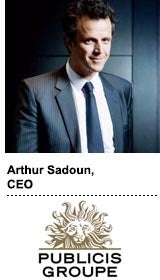
Publicis is still clearing up confusion among its employees, clients and investors about its offering and value prop since it acquired Sapient in early 2015.
“We are currently making sure our model is clear for everyone,” CEO Arthur Sadoun said on the company’s third-quarter earnings call Thursday. “We have to start with our people so they understand what we do.”
Despite recently winning accounts from McDonald’s, Lowes and Walmart, Publicis’ journey to transform from marketing services provider to a partner helping clients through disruption has been slow to catch on. Publicis wrote down its $3.7 billion purchase of Sapient by almost half its valuation in 2016 because it was dragging down the business.
Investors on the call asked multiple questions about Publicis’ business model and how they should measure its success. Sadoun told them to focus on organic growth and client stickiness, metrics investors typically use to evaluate advertising holding companies, and suggested that its change in direction warrants a change in valuation.
“I want to believe that, at one point, somebody will realize it will change our valuation,” he said.
Publicis has made some progress convincing clients of Publicis.Sapient’s new position. The firm in August beat Accenture for McDonald’s retail transformation account, on which it will team up with IT consulting firm Capgemini to build a digital retail experience for the fast food chain. (It will be interesting to see how the two firms work together, as Capgemini has hinted at its own intentions in the advertising space.)

Internally, Publicis reorganized extensively to facilitate Sapient’s business. The group launched Spine as a data and technology stack for its entire organization last week and reorganized Publicis.Sapient under industry practice areas to put experts across agencies on client teams.
Publicis also broke down silos at the country level in Europe and Asia this year and implemented 35 client leaders representing a third of the group’s revenue. About half of Publicis’ revenue comes from its “power of one” model, which pulls talent from across disciplines on client-focused teams.
It’s been an expensive process, said Chief Financial Officer Jean-Michel Etienne.
“It is true that we will have a very significant cost regarding restructuring for 2017 after H1,” he said. “We at no point want to slow down the transformation to avoid the costs that we have to incur.”
But the reorg still isn’t over.
“We are only at the beginning, and it is a profound change,” Sadoun said. “It is not an easy ride and it will continue to have some bumps in the road.”
To facilitate the process for employees, Publicis hired a new chief talent officer and will relaunch its training program next year.
“It will take time to make sure 80,000 people are trained,” Sadoun said.
To appease investors, Sadoun stressed the group’s focus on improving organic growth by being “extremely aggressive” on its new business pipeline.
“The short term is clear: We need to recover good organic growth, do very good work on cost and this could not wait,” Sadoun said.
Publicis Groupe’s Q3 earnings Thursday (1.2% YoY growth to $2.7 billion) fell slightly below analyst expectations of $2.8 billion.
This growth was an improvement from last quarter’s 0.8% growth. For the nine months ending in September, Publicis was flat year over year, growing 0.3% to $8.4 billion.
“We take it as an encouraging sign in what we will call a challenging environment,” Sadoun said.
Publicis declined to deliver an outlook for Q4 but assured analysts that it will perform better in the second half of the year than the first, when growth was -0.2%.
“We have always said that Q4 is an adjustment quarter for the advertiser and it is very difficult to predict,” Sadoun said. “But we expect to show an improved H1 to H2. We are really focused on bringing back the growth you should expect from us.”








