
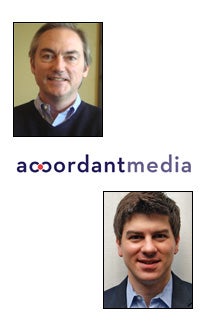
 Art Muldoon and Matt Greitzer are Co-Founders of Accordant Media, a media buying and optimization company for agencies and in-house marketers.
AdExchanger.com: Please share a bit of background. Where did you come up with the idea for Accordant Media?
Matt: The idea behind Accordant is that we integrate strategy, technology and execution to provide a complete buy-side solution for audience targeting and exchange-traded media.
Art and I worked together at Avenue A (now Razorfish) for many years and we each have deep buy-side experience. Art was GM in our New York office and most recently he led the global marketing data and media attribution initiatives at Aegis. I ran the SEM practice at Razorfish and also launched ATOM Systems, Razorfish’s agency trading desk which is now part of Vivaki.
Honestly, we came up with the idea on the back of a napkin over lunch after a ContextWeb panel, so we owe Jay Sears some thanks for that. We recognized there is a proliferation of technology and data providers, but few buy-side parties with expertise piloting these technologies on marketers’ behalf.
What problem is Accordant Media solving?

Art: We offer the advantages of audience-based buying solutions without the complexities. Many agencies and advertisers don’t want to own the responsibility (“hassles”?) of solving for new technology vendors, data integrations and staffing/utilization at the expense of managing their client relationships, strategic and creative work. Accordant is a trusted media buying specialist providing transparency, control, insights and expertise to succeed today. We also believe there are huge strides to be made in integrating disparate data sources to develop rich, targetable audience segments. We have a unique point of view on how this is best accomplished and make micro-segmentation a core part of our model.
Do you consider Accordant a services or technology company?
Art: Accordant Media is a technology-enabled services company. Our clients want reliable services that the pure tech players can’t provide given their business models. We utilize best-in-class enterprise technology partners where it makes sense to do so, while developing our own proprietary audience analytics and data/campaign optimization tools. Whatever you want to call it, our clients are relieved to find a company like ours willing to take a service-forward approach to an increasingly important and effective marketing channel.
Why can a services company “work” in digital media?
Matt: We don’t think “service” is a bad word and believe we can manage an attractive business in this area. The problem plaguing many services businesses in digital media is they are stretched too thin to scale: they want to develop custom, high-value solutions as clients’ strategic partners, and they also want to command technical and tactical expertise with a point of view on the 200+ companies in the ad tech landscape. Only service businesses at massive scale play both these roles. We aim to take the execution and technical integration components off the shoulders of agencies and in-house marketers so they can focus on building relationships and responding to customers.
Given your backgrounds in search marketing, what are the pitfalls that you see search marketers discovering in display media?
Matt: The level of complexity involved in making display work is far greater than that in search, so search marketers do not engage with display media at all because it’s just too confusing. For those who do engage I believe they make the same mistakes that traditional display marketers make in focusing on the wrong metrics. Search marketers often expect search-like results from display, and that’s just not realistic with a push medium. Display can be effective in and of itself, but it is even more effective as a driver of response at some later date – through search. We don’t see many search marketers using, and measuring, display as an SEM amplifier. That’s a big missed opportunity, and one we aim to address.
Where will social media advertising fit in your plans? What’s your view on advertising through Facebook?
Matt: We are certainly interested in the social graph as an audience targeting mechanism. Beyond that, we think Facebook’s ad platform is an extremely attractive advertising vehicle given its potential to deliver search-like targeting through micro-segmentation of audience. In that respect it is entirely consistent with our thesis around micro-segmentation. To the extent clients demand it we plan to make Facebook advertising part of our offering.
Would the Accordant Media model work across other media channels as well?
Matt: Absolutely. We view our approach as channel agnostic and are focused on a broader concept of what we term, “algorithmic media.” A core component of our business involves optimizing across search and display, so our approach is already cross-channel. Beyond that, we are building the audience profiling, segmentation and analysis techniques that will allow us to support additional channels such as digital video, mobile, email and any other biddable media channels.
Are you pursuing funding? What are your plans here?
Art: We are currently raising a modest seed round. We’ve been self-funded and want to accelerate our applications development, partner integrations and business scale with the support of a few strategic investors.
What milestones would you like to have seen the company achieve a year from now?
Art: We are passionate about seeing more agencies and in-house media buyers deploying advanced audience targeting and biddable media tactics as part of their campaign strategies. We want to be known for making advanced media buying simple and effective. We want our clients to become heroes for choosing us – our industry needs more heroes!
Follow Matt Greitzer (@mattgreitzer), Art Muldoon (@amuldoon) and AdExchanger.com (@adexchanger) on Twitter.








