

 There’s no larger driver of brand awareness than a 30×60-foot cinema screen.
At least, that’s the logic for Swedish auto manufacturer Volvo, which is test driving 90-second interactive cinema ads targeting 18- to 34-year-olds across 100 Screenvision theaters in the US.
The effort involves partnerships with cinema advertising company Screenvision and interactive, motion-detection company Audience Entertainment.
As part of a cinema’s pre-show entertainment, theatergoers can essentially test drive a new Volvo XC90 directly from their seats. First, the audience is presented with an ad featuring the new Volvo’s interior on screen.
Then, Audience Entertainment’s motion sensor technology triggers and prompts the audience to “lean left” or “wave your hands” in order to activate different aspects of their driving experience: music, day or nighttime driving and speed of the ride.
Although this is its first stab at a motion-based cinema ad, Volvo is known for futuristic brand campaigns. For instance, it used Google Cardboard last November to create a simulated test drive around the launch of the XC90 SUV using virtual reality and an app.
Experiential installations in cinema-based advertising are increasing in popularity with brands and advertisers, said John McCauley, EVP and head of strategic alliances at Screenvision.
Although the company did not disclose the cost of this campaign, cinema advertising is garnering attractive investments from agencies. Omnicom, for instance, signed a $50 million commitment with Screenvision’s competitor, National CineMedia, in March.
“Brands are more purposely carving out dollars that can be allocated from television to cinema,” he said. “It’s the first time I’ve seen this volume. Normally we’d find ourselves competing for whatever was left on the table after they’d cut their TV upfront deals, but we’ve been crafting more commitments with a wider array of agencies much earlier.”
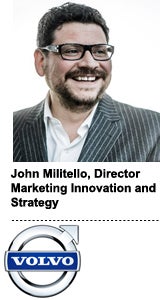
Volvo’s new director of marketing innovation and strategy, John Militello, joined Volvo in June to strengthen the brand’s in-house marketing strategy. He brings six years of experience as head of creative at Google’s in-house agency, the ZOO.
Militello spoke with AdExchanger.
AdExchanger: Why an interactive cinema ad?
JOHN MILITELLO: It is an opportunity to orchestrate new engagements with consumers and meet them where they are rather than pushing our message to them. Volvo’s done innovative and experiential things on technology platforms, but we want to do them more consistently.

We’ve been in cinemas before in the past, but this is our first interactive ad. When Mindshare and Grey [the agencies that brokered the deal] brought this to us … we wanted to be a first mover.
Do high-touch cinema ads come out of your TV or digital budget?
We’re a niche brand. Instead of competing on a large-scale, mass-market approach, where can we touch people in the places they go?
Some of that is still mass media (like TV), but with digital it gives us a little more focus. What’s appealing to us about the theater and interactive formats was it’s a place where people were actively going to see a movie in a group and have a discussion afterward. We’re not just putting up this commercial, we’re allowing them to experience our cars. We wanted to crowdsource an experience where moviegoers could say they controlled the big screen and talk about it afterward.
Who is the Volvo target buyer?
Like all brands, we try to skew younger, but we’re reaching a higher household income of $150,000-plus for [the Volvo XC90]. It’s a big step up in vehicle from any model we’ve had in the past, the flagship of a new line of cars coming out which will have similar amenities and technology. We’ve always been a very inclusive brand, but we’re also a premium brand. We wanted to shift that mindset so that luxury doesn’t have to be for a select few.
How do you determine if the cinema campaign helped you sell more cars?
People didn’t always know what was unique to our cars. The goal is obviously to sell more cars, but what we’re doing in cinema is one step closer to getting people into a car to experience it. It’s one thing as a brand to share what we stand for, but people need to understand what the product means to them.
Are you pushing this campaign out to mobile or digital channels to drive incremental reach?
The expected behavior is that people will pick up their device, take a photo of the crowd, Instagram, tweet or otherwise post to social media. But then how can we capitalize on that? We want to increase our share of voice and create campaigns that have a lot of earned media attention as well on digital.
We used to write good copy and got into a mentality as marketers to tell a story, but now with high-touch installations and Google Cardboard and Oculus Rift, we’re entering a new dimension of advertising, not just show and tell, but experience.
Who’s the biggest disruptor in video?
Right now it’s Periscope and Meerkat and live video. I think Facebook video is amazing, and I saw that back when I was at Google. Even though it wasn’t searchable, it was in your stream and it autoplays and you click for sound and it took off faster than myself and my colleagues thought it would. This personal live stream and the fact that almost anyone can have a live TV show and how do you broaden that two-way communication? The audience is still limited, but this didn’t exist until now. You’re getting real-time input from consumers.
How do you balance marketing decisions you make in-house vs. your agencies’ purview?
Being a creative, you want to grow a great idea and you want it to win an award. It’s like your baby. But starting with the YouTube influencers and celebrities, you [began to see] brands [moving money and resources] to third-party video creators.
We met with Mindshare yesterday talking about orchestrated engagement, and this idea of a campaign deck. … Do we need a campaign? We need a focus and idea around a problem or message. You’re seeing Coca-Cola, Unilever, P&G now who have multiple agencies – creative and media – working together. For better or worse, we’re seeing flux … agencies need to adjust to see where they can be more agile.








