 Adidas-owned Reebok is in a unique position, both as a challenger to Nike and as a target of other challenger sports and apparel brands like Under Armour.
As such, it invests heavily and consistently in content – despite its fluctuating ad spend over the years.
Because content must generate larger, measurable performance results, Reebok bets the walls will fall between “paid” or “working” media and non-working media, which more often than not fuels the production of content used across channels.
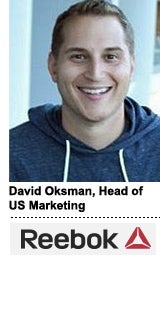
“Too frequently, marketers set volume targets for content, but for us, we’re very focused on making sure that content is not being produced for the sake of content,” according to David Oksman, head of US marketing for Reebok. “We’re trying to figure out, ‘What are the KPIs that mean we were ultimately successful with the content we produced?’”
Oksman spoke with AdExchanger about the evolution of data-driven content.
AdExchanger: Is content marketing becoming more measurable?
DAVID OKSMAN: Data has shown there’s significant increases in spend on content creation, but engagement rates are staying relatively flat. This invites the question, “Should we as marketers be reducing our amount of nonworking media spend?” We’re lucky our engagement rates are outperforming this trend. Instead of just looking at how to tell more awareness-level stories, you need to look at what success looks like for any given campaign.

What is Reebok doing to answer that question?
We make sure that we’ve got objectives and KPIs set up not just at the top of the funnel, but across the entire consumer purchase funnel, in order to maximize content. Another point is, should we be reducing what is known as nonworking media spend in order to invest more in working media?
Even the [phrase] nonworking media spend is a misnomer. If your creative is good, it will find eyeballs. If you are creating very good and compelling content, you probably don’t need as much media to invest if consumers are sharing it. It’s important to be thinking about this as creative media spend.
The content we’re creating as well as the dollars we’re spending on media are really just about finding the right efficiencies in order to maximize reach. The balance of content creation and media investment is something we’re thinking hard about.
You mentioned thinking beyond upper-funnel tactics. Is performance entering the brand equation more?
One hundred percent. Beyond the engagement piece you have with content, you can’t have a leaky funnel. And the way you avoid a leaky funnel is to be able to leverage some of this higher-level content to get consumers into your digital ecosystem. If you’re not tagging that consumer and tracking them through the process, whether it’s retargeting them on brand or on product messaging, and moving them into your CRM system, you’re just giving away the engagement and I’m not sure you’re making as much impact as you can from a performance perspective.
What has Reebok done to counteract that?
The team here has done a good job of looking at content creation engines or partners like Vice and a music app called Backstage. So it’s not just creating compelling content that leverages our brand’s messaging through these platforms, but also closing the loop, and leveraging other technologies [like marketing data platform Beckon] to make sure you are delivering against the consumer funnel and be able to see a full picture of how our efforts are connecting back to media spend or sales performance.
Rather than investing significant dollars to reach a broad audience, I think marketers are recognizing that through authentic engagement through communities or platforms where the consumer is choosing to participate in, then our dollars can be much more efficient and effective. The top of the funnel is softening in some ways to give way to deeper personalization and segmentation.
Does this change your view of traditional media investment, in say, TV?
I’m not saying they’re over, but the days of doing huge media campaigns with significant TV investments in order to drive instant performance – that game is changing. TV will still deliver reach in a way few vehicles can, but I think the consumer now, especially with a millennial mindset, has shifted.
Where is Reebok most interested in investing, mediawise?
As marketers, we spend 75% on the things we know work, 15% on things you want to try and 10% on the new, crazy shit. For me, that holds up in this framework. When you look at the platforms out there, we’ve done some tests with virtual reality, since we like to push ourselves to the limits.
On the platform side, specifically, Facebook is a much more mature platform. The consumer is in a little bit more of a closed environment with their community, but they’re much more apt to engage with us to drive clicks and even potentially to drive purchase.
Instagram is great for driving style, credibility, authenticity and depth of brand. But it’s more of a closed environment where consumers don’t really leave that environment to engage directly. Snapchat – we’re in the earliest of incubation and the opportunity at this point there is engagement and driving a cool factor with the consumer.
Interview edited for clarity and length.