By Konstantin Bayandin, Founder & CEO at Tomi.ai
Every advertiser knows the value of using microsegmentation to target audiences most likely to buy a product. But only the savviest online advertisers know the inherent downfall of that approach – and how to overcome it.
With predictive optimization, you can still target the highest-performing audience segments without ignoring the majority of your potential customers for greater return on ad spend (ROAS).
The problem with microsegmentation
Microsegmentation is a binary, all-or-nothing strategy. Advertisers can use tools such as Facebook lookalike audiences or Google Ads Customer Match to target consumers that resemble previous customers. Or advertisers can target audience members based on personal attributes, interests and demographics using tools like Google Ads Audience Targeting. Either an audience meets your segmentation rules or it doesn’t. Unfortunately, there are a lot of people who would be interested in buying your product – if only they had heard about it.


How many customers are you missing out on with microsegmentation?
Microsegmentation, or microtargeting, causes you to lose out on 50 to 90 percent of your total possible customer base. Let’s walk through an example using real Tomi.ai client data to show you how the numbers stack up.
Let’s bin the customer’s entire possible audience into 100 buckets, each representing one percent of the total audience population. The buckets could be binned by attributes such as predicted lifetime value of a contact (Figure 1).
Figure 1:

Each 1% bin is sorted randomly along the x-axis. Conversion rate is on the y-axis.
In this example, the best bin converts at 48 percent, the second-best bin converts around 36 percent, and so on. Looking at the cumulative order data (Figure 2), we see that the top one percent of the audience is 8.7 times more likely to purchase than the average audience member. Additionally, the top 10 percent of the audience provides 43 percent of the orders.
Figure 2:
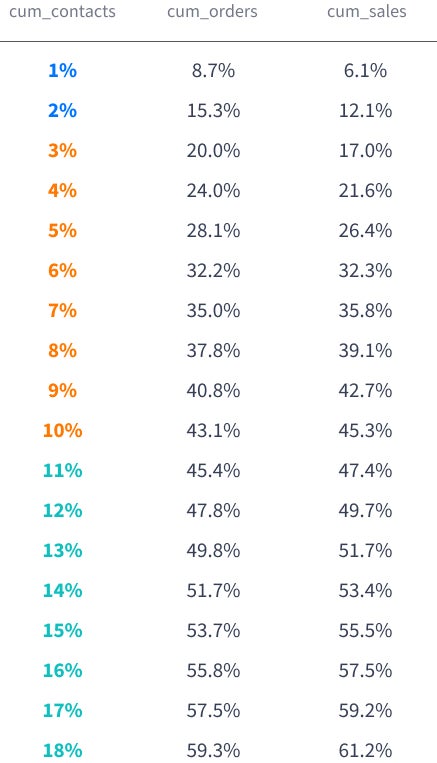
With microsegmentation, advertisers might create a lookalike audience on Facebook using the top two percent of the audience, or even the top 10 percent, but they are actively turning away up to 57 percent of the potential orders!
Why is predictive optimization more effective?
With predictive optimization, advertisers can use conversion data for each audience segment to reach an entire potential customer base without compromising ROAS simply by bidding less for lower-converting audience segments.
Predictive optimization can be implemented via an easy-to-follow, repeatable six-step process:
- Website pixel – A pixel is installed on a client’s website to collect first-party visitor data, including on-site behavioral tracking, for every visitor over a designated time period.
- Customer data – Website behavior is combined with the client’s customer relationship management (CRM) sales data over the same time period to get a complete picture of customer behavior.
- Machine learning – The customer data is used to train machine learning models.
- Optimization signal – The model then outputs the probability of an individual visitor’s likelihood to convert.
- Smart bidding – Finally, the optimization signal data for five to 10 percent of the highest engaged website visitors is fed into Google’s and Facebook’s smart bidding algorithm to bid the right dollar amounts for the right customers — without any targeting.
- Profit – The client sees high ROI without omitting a large segment of potential customers.
Predictive optimization is predicated on the premise that every audience segment is worthwhile, as long as it can be advertised to at the right price per impression or click.
Why is now the ideal time for predictive optimization?
1. Ad platforms are smarter.
Ad platforms like Facebook and Google have shifted to more automated bidding and smart-bidding strategies.
Because advertisers can use predictive optimization that integrates customer behavior with CRM sales data to train smart-bidding algorithms, there’s plenty of data to optimize for value-based signals like conversions or revenue instead of blanket segmentation.
2. Ad platforms are more open to conversion API integrations.
As recently as last year, Facebook allowed server-to-server data integrations only for their top hundred or so advertisers. Now, it’s open to any advertiser, enabling predictive optimization providers such as Tomi.ai to integrate client data directly into ad campaigns for smarter bidding strategies and optimized ROAS.
Predictive smart-bidding optimization uses predicted purchase value as the optimization goal, so you can deliver advertising algorithms with a non-binary input that allows ad platforms to optimize for the right signal – for superior conversion value for the highest engaged potential customers.
And that leads to more sales and optimal ROAS.