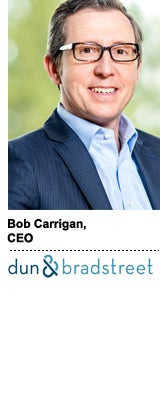
 Microsoft, which spent $26 billion on LinkedIn, isn’t the only company betting big on B2B data.
Business database Dun & Bradstreet (D&B) also placed wagers over the past year by striking 16 strategic deals with publishers, agency trading desks and vendors like LiveRamp, Xaxis and Adobe.
Despite being known for its commercial credit listings and business research, company CEO Bob Carrigan said D&B aims to activate more business user data programmatically for marketers, either directly or via third-party partnerships. Risk management still makes up 60% of D&B’s $1.7 billion business, but marketing solutions and sales is a close second at 40%.
“Programmatic is coming into the B2B world in an aggressive way,” Carrigan said. “The ability to work beyond walled gardens and across multiple types of media is a big problem for B2B marketers, but is even harder to do in B2B because you have this multilayered buyer.”
D&B claims it has a massive deterministic database on some 250 million businesses in 220 countries (built partially through acquisitions of business information firm Hoover’s and NetProspex over the years) organized around a single identifier – a nine-digit business classifier called the D-U-N-S number.

Carrigan spoke with AdExchanger about its implications for marketers.
AdExchanger: Why the expansion into programmatic?
BOB CARRIGAN: As [B2B companies move into digital and programmatic], more attribution is expected. A lot of companies were already using [our D-U-N-S number identifier] as part of their master data management or CRM strategy, but activating it in advertising to connect a programmatic lead to your CRM database is another use case.
What’s special about D&B’s data set?
We capture deterministic information, not just web-based behavioral data. This is financial, social signal and government registry data. Once we’ve onboarded that data and match it back to [behavioral data through the tool WebVisitor ID] in the online world, it becomes a powerful deterministic data set. It’s much harder to get B2B data in the behavioral context since they’re much more multifaceted.
Isn’t this what the Microsoft/LinkedIn deal hopes to solve?
It underscores the strength of the B2B marketplace, which in keeping with the trend of B2B following B2C is increasingly embracing data and analytics for customer insight and engagement. … The challenge has been that scale issue. One of the reasons we’re growing nicely is we have scale, but we’re not selling only within our walled garden. We can work across a lot of different sources.
Will you execute buys or stick with the data business?
We’re a data company. We’re not a media company or a CRM company. We do business with companies like eXelate (Nielsen) and Salesforce, but we never aim to build a front end. Our business influencer data helps those systems become more efficient.
All the technology we invest in is to make sure that data is actionable and embedded in broader workflows. Having predictive analytics that sit on top of the data are also part of our innovation. We own this data. We are not an aggregator, so figuring out ways to use this data in the programmatic world is interesting.
Are you only supporting B2B campaigns?
We have some advertisers who come from purely consumer companies looking to target our prospects – [where maybe there is] a CIO who works at a certain type of company who likes to golf. It’s kind of an unintended benefit that we’ve enjoyed, but our focus is really people in the context of business. Those lines are blurring [with B2C] thanks to technology and changing work-life balance. So it’s not surprising that there are more B2C campaigns being activated against our audiences. But we like to say we have deterministic data about buying power in the context of business.
Interview edited for clarity and length.