
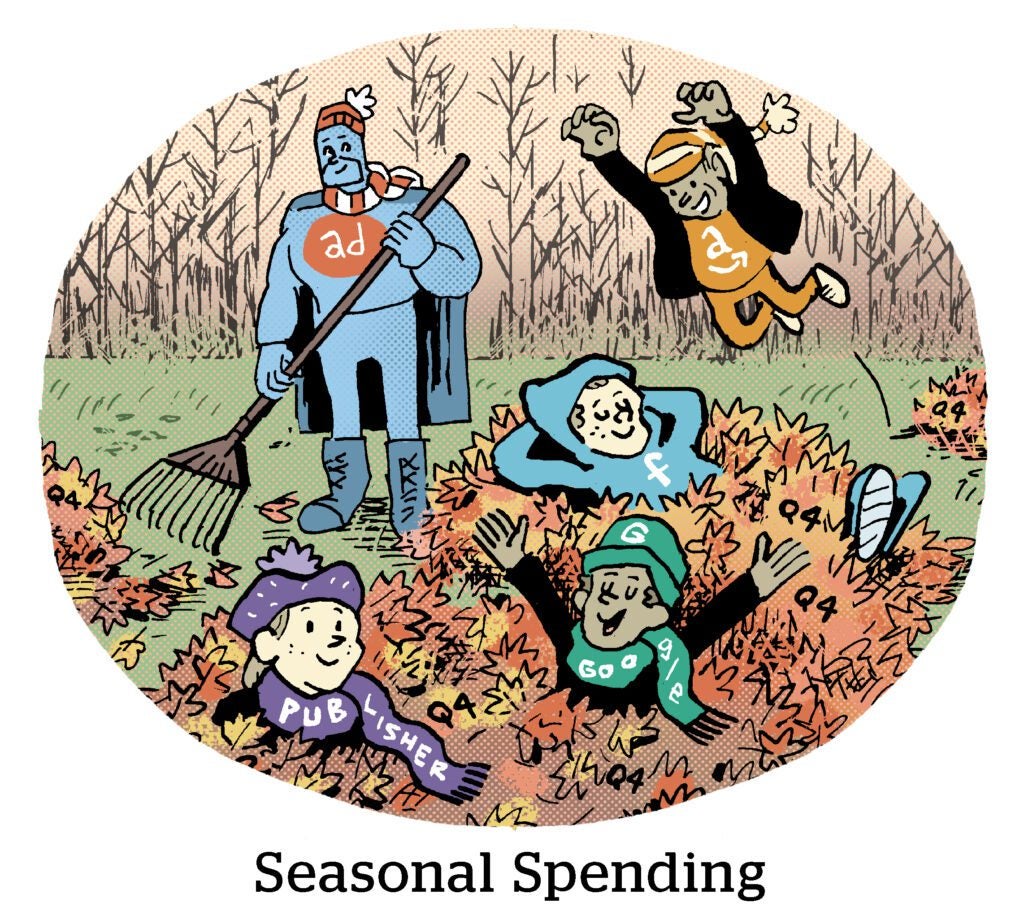
Amazon The Impervious
Google and Facebook are reeling from data privacy changes. Tim Cook warned investors that Apple underestimated part shortages and would not meet demand until next year. Macy’s slimmed its store inventory. Disney’s production schedules are delayed by months and even years.
And Amazon is – doing great.
The ongoing supply-chain drama, COVID-19 fallout and privacy earthquakes striking at Amazon’s competitors seem to only buoy Bezos’s baby.
In a week or so, online retailers and merchants will begin notifying shoppers that items won’t be delivered by Christmas, and sellers will be left hoping for a holiday miracle from FedEx or UPS.
But Amazon is making a compelling case that it can deliver products in time – if merchants enroll in its fulfillment program, of course, according to Ben Thompson at Stratechery.
And if stores limit inventory due to production delays, shoppers will inevitably go online, where guess who picks up even more market share. “This is critical because aggregating customer demand is the foundation of Amazon’s moat,” Thompson wrote.
Elsewhere, while Apple’s AppTrackingTransparency policy rocked walled-garden platforms, Amazon was left unscathed. Amazon doesn’t rely on a network of site pixels or in-app SDKs; it runs Amazon ads on Amazon media that convert to Amazon sales.

BuzzFad
With its IPO on Monday, BuzzFeed became the first publicly traded digital-native news company.
Company shares opened at $10.99, and during an up-and-down first day on the Nasdaq, the price rose by as much as 40% before finishing the day down about 11%, CNN reports.
BuzzFeed went public following a SPAC merger, which priced the publisher’s shares at $10. The SPAC had raised a trust account totaling roughly $288 million, but after the majority of investors redeemed their stake in the trust for cash, the total amount raised by BuzzFeed was just $16 million. BuzzFeed also raised $150 million in debt financing.
The company’s IPO comes at a strained moment between BuzzFeed management and staff. To coincide with last week’s shareholder vote to go public, BuzzFeed employees staged a walkout to draw attention to ongoing contract negotiations between management and the BuzzFeed News union.
Since its SPAC merger announcement, BuzzFeed acquired digital media brands Complex and The Huffington Post. BuzzFeed plans to add more digital publishers under the BuzzFeed umbrella, according to CEO Jonah Peretti.
The company’s market cap sat at $289 million as of close of trading on Tuesday.
Safety First?
The family safety app Life360 is under scrutiny for selling location data. The app claims its data is anonymized enough to safeguard users (and especially children), but privacy professionals and former employees told The Markup otherwise.
The app admits to sharing data. So, what’s the problem? For one, Life360 doesn’t tell users they can turn off the location-sharing setting. This elusive “opt out” leaves the precise location data of millions of users up for grabs. Life360 claims to strip obvious identifiers, such as names, from its data, but device IP addresses and location coordinates are still fair game. And even though it prohibits user reidentification, Life360 doesn’t actually have a way to keep close tabs on its partners.
Life360 also sells data through its own personal servers – free from detection by Apple’s and Google’s app stores.
And with no checks and balances, it’s hard to take Life360’s word that it doesn’t sell data for law enforcement purposes, as others have been found to do. One of Life360’s data brokers was caught selling data from a Muslim prayer app to government national security efforts, Vice reported earlier this year.
It’s hard to say Life360’s parental tracking is worth the collateral damage when the location data of young children is for sale.
But Wait, There’s More!
Industry Dive’s path to $100 million in revenue. [The Rebooting]
New tech regs are coming. Morgan Stanley says buy Alphabet and Meta anyway. [Barron’s]
The data and analytics company Datrix lists on the Italian stock exchange. [release]
Ownership groups representing 200 newspapers have sued Google or Meta over antitrust concerns this year. [Axios]
Netflix and TikTok have supercharged fame. It’s all about fads now. [NYT]
Cookie compliance efforts continue to fall short even three years after GDPR. [Digiday]
You’re Hired!
Smartly.io adds Lyle Underkoffler as chief marketing officer. [release]
Index Exchange Hires Ray Ghanbari as CTO. [release]
Foursquare announces Oren Teich as SVP of product. [release]







