

McCann Worldgroup has always operated under an integrated agency model.
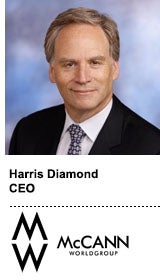
The IPG-owned network, whose agencies include media agency UM, creative agency McCann, database marketing agency MRM McCann, brand experience agency Momentum Worldwide, McCann Health, PR agency Weber Shandwick, shopper marketing agency ChaseDesign and a handful of other production and design shops, was founded in the 1990s “with the concept of bringing disciplines together,” said global CEO Harris Diamond.
One of Worldgroup’s most recent successes is “Fearless Girl,” a bronze statue of a Latina girl staring down the “Charging Bull” on Wall Street. McCann New York created the statue to advertise State Street Global Advisors’ gender-diverse index fund. Worldgroup collaborated to spread the statue’s promotion of a diverse workforce across channels, winning four Grand Prix and 18 Lions at this year’s Cannes Lions festival in June.
“That is what Worldgroup brings to the table,” Diamond said. “The ability to seamlessly focus on one idea and amplify it on multiple platforms.”
McCann Worldgroup has had a standout year within IPG. The agency, which ranked highest for client wins in Q1, has won 239 new clients in 2017, including Accenture, Coach and Chick-Fil-A, according to marketing consultancy R3.
Diamond spoke with AdExchanger.
AdExchanger: Was the impact of “Fearless Girl” a surprise to you?
HARRIS DIAMOND: Yes. I thought it was the right thing for that client. My creative team thought it was going to tap into a social dynamic in the US. But when you catch lightning in a bottle, you’re always surprised you caught lightning in a bottle.

There are a lot of components at play with “Fearless Girl,” from execution to media to PR. What’s the coordination like between agencies?
We use agencies as places where intellectual capital resides. The magic is bringing those disciplines to bear on one idea.
You’ve got a lot on your mind, between PR, experiential, media, etc. How do you deal with that?
I make sure my team and I keep up with cultural aspects in society. How are people receiving information? Is Facebook tomorrow a medium by which video will make sense? Where will newspapers be? How many people are still going for TV advertising versus product placements?
Do most of your clients work in an interdisciplinary way across Worldgroup?
We have 4,000-plus clients. Some utilize us for one discipline. That’s always going to be true in this business. But most are headed toward thinking about us as marketers rather than discipline-specific. Worldgroup was founded under that concept, probably too early.
Why was it too early?
Y&R in the ’70s came up with the concept of “the whole egg.” They couldn’t get traction. [When Worldgroup was founded,] again, I don’t think clients were ready. Today, most clients [know they] need marketing rather than a specific discipline.
What’s the difference?
To take a product to market today, it’s rare that you use one platform. You give the consumer information in different spheres. If ideas resonate among all, that’s the perfect marketing program.
How do walled gardens affect the ability to do marketing across platforms?
Every one of them wants 100% of our share. At that moment, the walls fall down. They’re in our office, they’ll buy us lunch, throw flowers so we use their platform.
The walled garden is a problem in understanding that what they’re telling us with respect to our frequency and ability to reach a consumer is, in fact, happening.
Have you been able ensure a degree of transparency?
Not to the extent that would make me as happy as I should be. Too many platforms are still counting on their exceptionalism. The question is, is it worth a dollar or 50 cents?
From your standpoint, is there an exceptional platform?
Facebook, Google, Tencent and Alibaba are exceptional. There are platforms that have massive audiences and platforms that have specific audiences a client could be very interested in. We’re generally trying to find large audiences. That’s why TV is so successful.
How will TV change over the next five years?
I still think TV will have value. They constantly reinvent with better shows that attract broader audiences. A lot of people like getting TV for free.
There are a lot of popular shows, but they are more niche. None that pull in the numbers “Seinfeld” or “Friends” did. How does that factor into what you do?
On these [niche] audiences, we pay more. We still love sporting events because they’re large audiences and they skew specifically for age and gender. It’s easy for us to understand who they are. We still see a huge opportunity for those audiences. We’re going to figure out whether there are good live streams from ESPN that skew to an even more distinguishable audience.
What data expertise have you built or are you continuing to build within Worldgroup?
It’s more that we’re continuing to build. We’re trying to get as specific as we can. It’s understanding who people are, how they buy and how often we can reach them, while respecting privacy issues. We’re in the embryonic stages of that.
Eventually, people say we should know the individual. I’m not quite sure I want to be in that world.
Is this data asset going to be specific to Worldgroup or are you tapping greater IPG?
It will be a combination. We want to have the largest repository. We want all of the relevant agencies to have consistent access. We’re looking for a more active role to utilize data already out there.
Is there a discipline in Worldgroup you feel you need to build out?
Understanding consumer mindsets and how to approach consumers is a major focus of investment.
In digital, we keep abreast of changes. It is a complex world and it’s important that our strategists, account leads and creatives understand that.
What are your biggest unknowns going into second half of 2017?
As we see more dollars go to two platforms, we need the other platforms to be strong. I’m much more comfortable in a world with a lot of different media channels. I don’t want to see two major digital channels.
Ryan Joe contributed. This interview has been edited.








