 Bitly was known as the de facto Twitter link shortener back in 2008.
As that business commoditized – and Twitter, Google and other platforms released their own versions – Bitly recognized its real value was in the data exhaust left behind by its links.
That spurred the enterprise platform Bitly OneView, a tool it launched in early December to broaden the scope of Bitly’s value prop to brands.
Beyond selling Bitly-branded domains to big marketers – Amazon’s branded URL is amzn.to, for example, while Pepsi’s is pep.si. – Bitly wanted to boost measurement.
Because Bitly’s system spans paid, earned and owned campaigns, it claims its links act like bona fide pixels that carry across open and closed platforms. Bitly OneView serves as a central hub where a marketer can track all of their links across platforms, Facebook or Twitter; device type, iOS or Android or channel, like email or in-app.
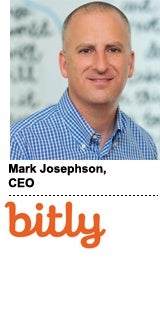
“One thing we’re able to see is overlap in engagement by channel,” said Mark Josephson, the CEO of Bitly. “We’re telling brands if they’re reaching the same user in multiple places and if they’re over- or underemphasizing certain channels or platforms.”
Josephson spoke with AdExchanger about the evolution of Bitly, the link shortener, into Bitly, the data platform.
AdExchanger: Bitly started on Twitter. What channels are you active in these days?
MARK JOSEPHSON: We’ve been around so long and have open architecture and about 36,000 developers using our platform, so marketers are using it in lots of new ways. For instance, using Bitly links alongside pixels in display creative, so that every time the creative loads they are tracking interactions with us through OneView.

The parallels with pixels have been interesting, as well as the fact that you don’t have to actually see the link for the Bitly component to be there. People think of us as the branded “Pep.si” or Red Bull’s branded link, but you never see a lot of what we do.
What emerges from those data connections you make for marketers?
We’re telling marketers where they can start to see more efficiency of their efforts from email to SMS or in-app. That’s one insight – channel vs. channel and platform vs. platform. The other metric is overall engagement per link and per user.
We can look at how many engagements you have per user, so for somebody in B2B, you might want engagement to be really high for content marketing, but in B2C, you might be going more for reach and awareness. So we rolled out benchmarking and the ability for a marketer to see how their engagement in a particular vertical compares to their peers.
Isn’t that attribution, to an extent?
What resonates with me about attribution is our ability to, in some of these use cases, do sales operations integrations, particularly in B2B, where there might be 10,000 customers or leads or targets for a big B2B product. Our customers are creating multiple links per record so they can track the effectiveness of the channel for each lead.
We talk about multiple touch points through the funnel. Because we get a billion clicks a month out of Facebook [alone], with an average total of 16 billion clicks per month [across all other channels including] email, SMS and display, we’re able to show a progression of those touch points across the funnel.
How do marketers integrate your system into their larger execution strategy?
The relative simplicity of the link is that it’s event-level marketing data that’s apples to apples across every single platform. We spend a lot of time going between marketers, publishers, ad servers and component stacks of marketing clouds to normalize numbers. A big aha moment for us was when we saw customers using our campaign builder across marketing clouds.
What do you mean?
We work with customers who use Salesforce, Adobe Analytics and [Oracle’s] Eloqua as their marketing stack. It’s very difficult for a marketer to take one look across all of those in an equal way. Our customers are now putting Bitly links in each of their marketing systems and use us to report and provide insight into the customer journey and experience across those systems.
Each time you click on a Bitly link, we correlate that to cookies and profiles, so we’re able to show a marketer how their campaign performed [when it was distributed from] Marketo vs. Twitter vs. Facebook or Salesforce.
What’s an emerging use case for Bitly beyond that data normalization?
Taking your owned and earned media assets and turning them into app re-engagement. With our deep-link technology, we help brands re-engage someone when they click on an email, for instance. HBO uses us for that, so when you get an email for HBO Go about “Westworld” or “Game of Thrones,” they want you to go to the mobile app, not mobile web.
Another use case is retargeting or targeting based on Bitly segments. In the past, we’d been cautious about it, but we’re in-market for [a Bitly data offering] with a couple of customers in alpha now.
What’s the future like for Bitly, with quasi-competitors such as AddThis getting snapped up by platforms like Oracle? And what other business logistics can you share?
We have lot of inbound [interest] on investment and acquisition, and my comment always is that we’re a venture-backed company and my job is [to] create value for our shareholders and customers. We’re at 75 people and have always run the business at or near profitability. We hired a new CRO about six months ago and have been almost exclusively focused on an account-based, outbound model against brands.
More than 90% of our business is brand, not publishers or agencies. We’re seeing a lot of pickup in pharma, health care, financial services and CPG. About 10 million people a month use our free service and 1,000 of the largest marketers in the world pay for our service.
Interview condensed and edited.