

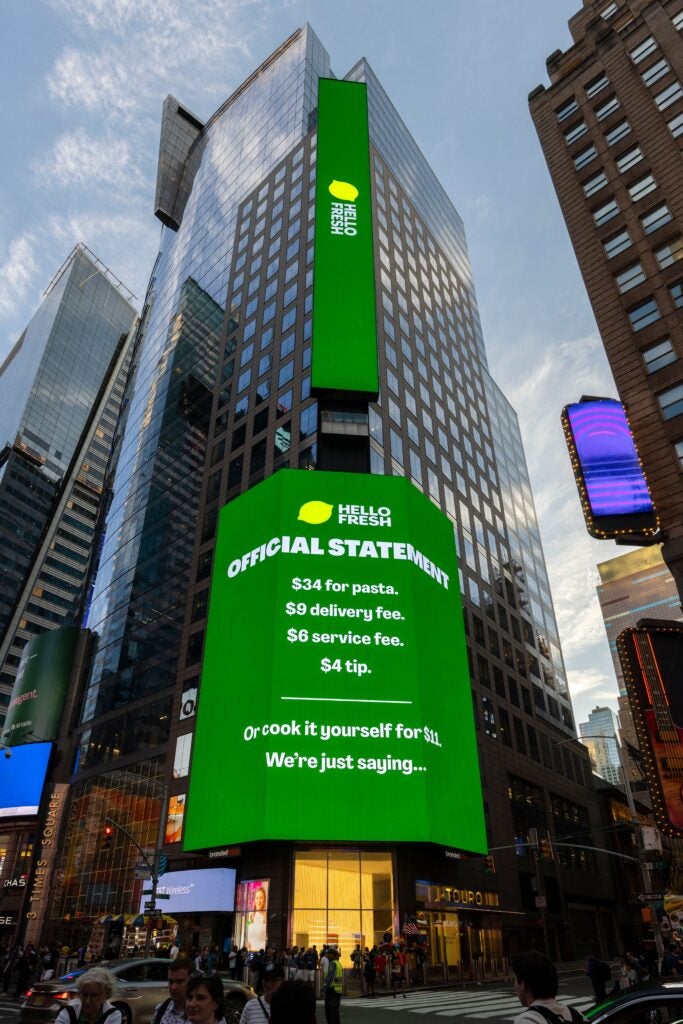
Have you ever walked through Times Square and thought, Wouldn’t it be cool if these giant billboard ads could be produced by AI?
This doesn’t seem like a universal experience. But for CDP Hightouch, apparently, this question was top of mind.
In June, Hightouch launched a one-day Times Square activation to showcase ads that its clients made using its new creative development tool, Ad Studio. The activation was funded by Hightouch and featured brands such as Sweetgreen, Tripadvisor and HelloFresh.
More is more
Brands are currently “under pressure to produce significantly more creative than ever before,” according to Conor Feeney, meal-kit company HelloFresh’s US head of marketing. As attention spans continue to decrease, fresh creative tends to perform better. Plus, he added, AI allows companies to test much faster and ensure that they are prioritizing their highest-performing creative.
HelloFresh adopted Ad Studio to meet this need for creative at scale. Ad Studio (which is one tool in Hightouch’s larger agentic marketing suite launched earlier this year) handles the creative process from asset generation to deployment across platforms. (Hightouch doesn’t handle the budget allocation or media buys, however.)
One of the biggest challenges in developing AI creative is ensuring that a brand’s voice doesn’t get lost or misrepresented, and that all of its content regulations are met.
Hightouch addresses this by using a brand’s own content (including product catalogues, legal and compliance guidelines and previous ads) for guidance. It has native integrations with ad channels and tools like Figma, so the assets can easily be pulled directly into the Hightouch platform. (They can also be manually uploaded.)
Like any tool, Ad Studio won’t necessarily create the perfect ad on the first try – but marketers can prompt it with natural language to quickly tweak and revise the initial draft. For instance, they could ask it to make the copy “punchier” or more relevant to a certain audience, or focus more on the quality of a product rather than a discounted price, said Hightouch co-CEO Tejas Manohar.
This speed of revision is a major draw for HelloFresh, which is focused not just on “iterating more creative,” but also “continuous experimentation” and testing, said Feeney.
People 🤝 robots
Amidst the increasing backlash against AI, one of the biggest criticisms has been its inability to generate creative that, well, doesn’t suck. After all, a predictive algorithm, by definition, isn’t going to generate innovative ideas.
But HelloFresh doesn’t see it like that.
Ad Studio doesn’t “replace the creative thinkers on the team,” Feeney emphasized. Rather, it allows HelloFresh to generate more output more quickly using existing creative and human revision.
And that’s exactly what Hightouch is aiming for. Using Ad Studio doesn’t mandate any sort of coding or technical experience, said Manohar. But it does require “a talented, creative person” who can articulate why something is a good (or bad) fit for the brand’s intended messaging and “put that into words that AI can understand.”
HelloFresh used past ads and promotions to shape the content used in the Times Square activation. The ad was intended to emphasize the contrast between the high cost of takeout and the affordability of a home-cooked meal, and “the value that’s implied” by opting for HelloFresh, Feeney said.
For now, the only ad that HelloFresh has created with Ad Studio is the one deployed in Times Square, but it plans to continue using the tool for future activations.
Next stop, Broadway?








