The Sound Of (Ad-Interspersed) Music
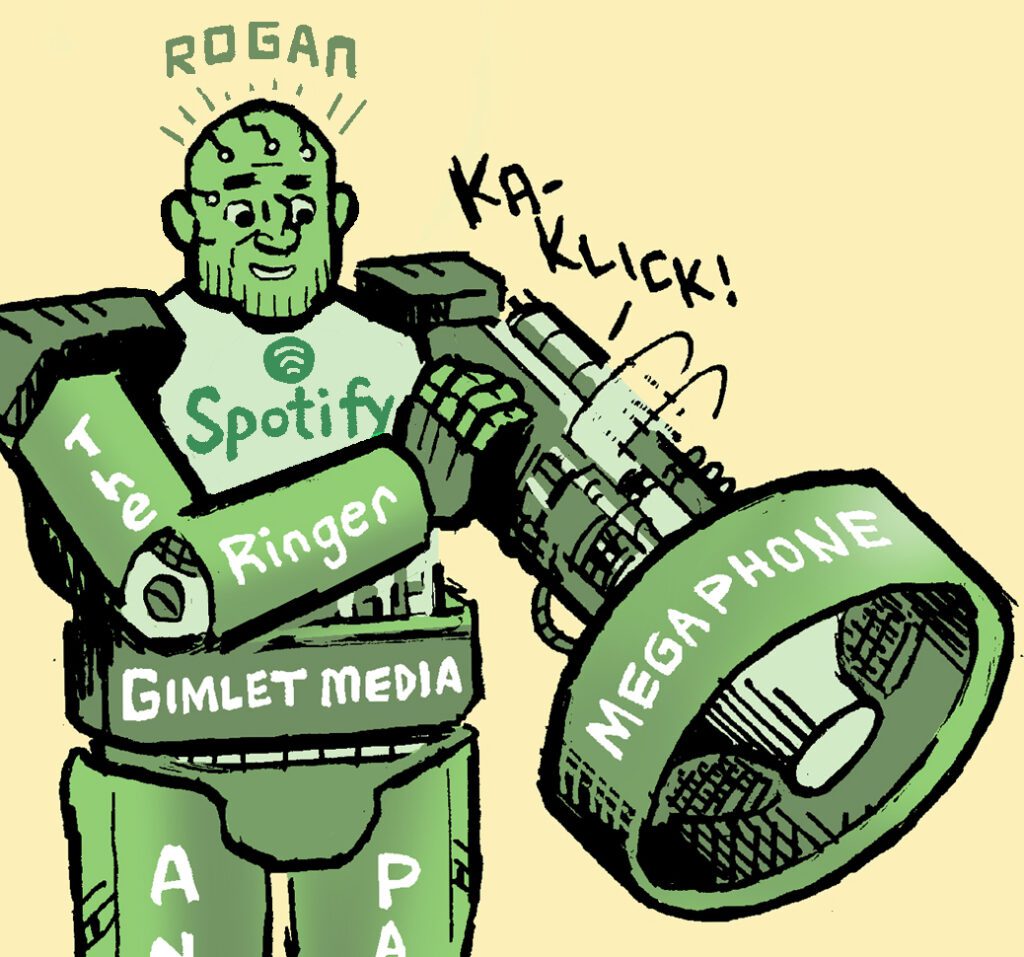
The number of advertisers bidding on Spotify’s programmatic ad exchange has tripled since its launch a year ago.
And this week, it’s releasing new ad formats, including sponsored playlists and swipe-through carousels, along with new back-end features like automated bid adjustments.

Spotify commands some 30% of the global music streaming market and attracted more than $2 billion in ad revenue last year. Still, the streaming audio platform is “only just” outperforming other companies in the sector, according to Digiday.
There are a number of reasons that Spotify’s ads business isn’t more lucrative. For one, most advertisers prefer to orchestrate direct deals for podcasts spots, since host-read spots create a unique “intimacy” between host and listener, says Patrick Stal, CMO at HelloFresh. This reduces the appeal and the inventory available to programmatic buyers.
Spotify is also hampered by ad spend on audio channels lagging behind other media types, even though buyers say they are eager to diversify beyond their big platform ad budgets.
“We’re hopeful that, as Spotify continues to evolve its exchange and supply, this will become a more viable path for us moving forward,” says Dana Heins, director of programmatic at NP Digital.
A MyScore To Settle
How’s this for a campaign ROI? Run a campaign that drives 2.7 million unique visits, attracts 169,000 new customers, earns $6.8 million in revenue…and one guilty verdict.
The US Attorney’s Office for the Southern District of New York, a unit of the Justice Department known for financial crimes prosecution (the SDNY encompasses Manhattan and thus the stock exchanges), culminated its case against the CEO of a network of credit-monitoring companies, formerly under the MyScore brand.
Where ad fraud came into the picture is that Michael Brown, the defendant who pleaded guilty, set up campaigns advertising attractive property rentals in expensive cities (New York City, Los Angeles and Miami, to name a few) at below-market rates. The fake rental listing didn’t contain an address but prompted interested visitors to email the owner, who would ask for a credit score and send a few links that would generate an easy score.
Obviously, they were links to his own credit rating companies. And what’s more, he enrolled people who used his credit services in a $29.94-per-month membership program that couldn’t be easily canceled.
Global Competition Control
Global Privacy Control (GPC) is anti-competitive, argues privacy attorney Alan Chapell in his Monopoly Report newsletter. But, he adds, GPC is also the future of online privacy.
GPC lets users opt out of targeted advertising using a single universal signal that must be honored across platforms, web browsers and ad tech.
But in practice, only a few web browsers currently support GPC, including Brave, DuckDuckGo and Firefox. Chrome, Safari and Edge do not.
However, starting next year, browsers must provide GPC opt-outs to comply with the California Opt Me Out Act. And, Chapell predicts, regulators will likely push CTV and mobile platforms to also adopt GPC.
But Chapell sees GPC as a way for browsers to lock users into their own ad products under the guise of privacy if they enable GPC by default. And most browsers have their own ad products these days.
For example, Brave blocks ads on publisher sites and instead features its own search and display ads, which it argues are more privacy-safe since user data isn’t tracked by any entity other than the browser. Every browser could copy this model using GPC as justification.
Some states recognize the potential conflict of interest, with Colorado and Connecticut passing laws against browsers enabling GPC by default. Chapell advocates for California to join the club before its new law goes into effect.
But Wait! There’s More!
Google explains how its Googlebot web crawler processes data. [blog]
A jury says Meta and Google hurt a kid. What now? [The Verge]
The audience numbers are in for Netflix’s first-ever MLB broadcast: The streamer’s Opening Night game averaged 2.97 million US viewers, compared to the 3.2 million fans drawn by NBC’s primetime MLB broadcast the following night, according to Nielsen. [The Hollywood Reporter]
Viral posts claiming to spot insider trading on Polymarket and Kalshi don’t have to be accurate to move the prediction markets – and influencers are being paid to boost them. [The Verge]
As of April 1, the NFL is without an official sportsbook partner for the first time since 2021, and negotiations are reportedly ongoing. [Sports Business Journal]
President Trump’s executive order defunding NPR and PBS was blocked by a federal judge, but the networks say the damage has already been done. [Ars Technica]
The new bundle: To counter subscription fatigue, three independent newsletters are offering a combined subscription. [Nieman Lab]