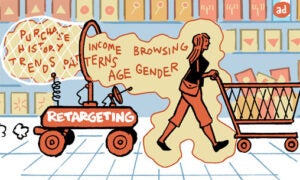
The advertiser imperative is simple: send the right message to the right user at the right time. The growth of the connected car has presented even more opportunities for brands to reach consumers in a context-specific environment and some service providers have risen to the challenge, like online radio company Pandora, which just began rolling out an in-vehicle audio advertising platform.
But the interest advertisers have in the connected car is, for now, a one-way street as the automobile manufacturers remain ambivalent to the idea of participating in the advertising ecosystem.
“That’s not in favor of Audi, because we are a premium brand,” said René Steiger, a user experience designer at Audi of America on the show floor of CES 2014. “We do not do commercials or send advertisements.” Steiger was helping showcase Audi Connect, an in-vehicle tablet run off Google’s Android operating system that will debut “in the near future” (he declined to provide a more specific timeframe).

Automakers’ chief fear is alienating customers. “This is a sensitive topic,” said Daniel Grill, senior manager at Mercedes-Benz Research and Development North America. “At Mercedes, we’re very concerned about our customers’ convenience, so whatever we do, it would have to be accepted by our customers. Maybe if our customers get benefits [Mercedes might consider advertising partnerships], but with a brand like ours, we’re not yet interested. We do a lot of customer research and we do things that make sense for our customers, that add value.”
And advertising through the connected car, from Mercedes’ standpoint, isn’t something that currently provides that additional value.
Complicating the situation is the fragmentation across in-vehicle systems. When it comes to the connected car, each automobile manufacturer has a different strategy – meaning there’s no single platform or operating system through which in-vehicle advertising could run. For instance while Mercedes connects with Android and iPhone devices and, announced at CES, the Pebble smart watch, it also has a closed app environment with around 20 apps developed by Mercedes itself (its Yelp, Facebook and Google apps were built off each service provider’s respective SDK), which download directly onto the car. “This is targeting the high-end customer that wants everything in the car, right there,” explained Mike Cheng, manager of smartphone integration at Mercedes-Benz Research and Development North America.
On the other hand, Ford Motor Company, according to one of its developers Heath Williams, supports a third-party developer community and open sources its code for its in-vehicle modules in order to expand that community. Ford even encourages other manufacturers of in-vehicle computing systems to use it. Ford’s strategy is to provide a link allowing apps on Android phones or iPhones to be controlled through the car’s electronic units.
Ultimately, the fragmentation in the device and software ecosystem that complicates advertising in mobile handsets and tablets exists within the connected car environment. Google’s Open Automotive Alliance (OAA), announced during CES and which includes automakers Hyundai, Audi, Honda and GM, hopes to begin consolidation.
Yet different iterations of Android will continue to exist among these differing carmakers. Audi’s Steiger said each carmaker will develop its own in-vehicle system from Google’s SDKs.
Thus far, it seems automakers are content to let third parties like Pandora work out the details around in-vehicle advertising, just as old fashion radio stations work out their own advertising policies. “It’s really up to the [app] developers, but obviously there are usability considerations you have to take,” Ford’s Williams said. So whether USA Today, whose app is compatible with Ford automobiles, translates an in-app, visual banner ad so it appears as a text ad on Ford’s display is ultimately up to them.
But as far as Ford working to create direct relations with advertisers for its in-vehicle systems?
“No. No. No,” Williams said. “I just haven’t seen it on the roadmap.”