

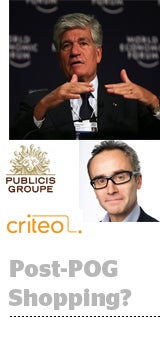
 It wouldn’t be the first summer weekend French agency holding company Publicis Groupe sent shock waves through the advertising ecosystem.
Close to the anniversary of the infamous ad merger of equals that never quite materialized as Publicis Omnicom Group (POG), French pub Boursier reported on a rumor the holding company could be close to extending a takeover bid for 9-year-old French ad tech company Criteo, which went public last October.
French financial daily Les Échos followed that report with a claim the deal has been in the pipeline for three months and could conclude in the coming days. Criteo’s stock shot up 19% in early trading Friday before the markets closed for the Labor Day weekend.
Will it happen?
Although neither of the companies confirmed anything (“It’s not our policy to comment on rumor or speculation,” said a Criteo spokeswoman), a prospective deal would be expensive, leading some industry insiders to question the rumor’s validity. Criteo has a $2 billion market cap and did $221 million in revenue for the second quarter, meaning it could cost Publicis an estimated $3 billion minimum.

“There’s so many reasons why this doesn’t make sense,” said Brian Wieser, senior analyst at Pivotal Research. “I was certainly on the record as saying Publicis and Omnicom was unlikely, too, but at least that had strategic and financial merit. The fact that they both happen to be French is a positive, yes, but the expense of it relative to alternatives is great.”
Others disagreed.
“Not crazy,” said an investment source who noted that Publicis trades at 9X forward EBITDA to Criteo’s 14. “So even with a premium, it will not be crazy dilutive – and a good counterpunch to WPP and rebound move post-POG.”
Although, the fact that the leak occurred is another reason to question its validity, the source added. If the deal were to transpire, it would have been conducted in a controlled fashion by Publicis-Criteo chiefs Maurice Levy and JB Rudelle, much like the PUB-OMC deal. “I’ll bet the buyer is a US firm,” that source predicted.
What if it does happen?
If Publicis is Criteo’s suitor – one of the most obvious beneficiaries of an alliance would be the addition of a programmatic ad platform to rival WPP Group’s Xaxis. Criteo would also give Publicis greater mobile prowess (Criteo acquired Ad-X Tracking and recently named Millennial Media’s Mollie Spilman as CRO).
But, how would Publicis go about integrating the retargeting technology in its organization?
“This is what perplexes me because agencies are not ad tech companies,” one source with knowledge of Criteo said. “If I were Publicis, I would say, ‘I’ll buy you, but I need to lock up your engineering talent for four years because I have no engineers.’ Also, when you onboard a company like Criteo, what do you do for independent clients, or clients who already work within the Publicis world?”
The agency could win additional accounts here, but the basis of Criteo’s business could be a roadblock. Although Criteo no longer identifies itself solely as a “retargeter” (it extracted this description from its F-1 filing and subsequent earnings reports), the company has a history focusing on bottom-of-the-funnel clicks.
“If the company relaxes its gold CPC standard and gets more CPM, [it’s possible]” the source said. “You can’t make a CPC model work for CPG and automotive companies because the availability of first-party data is not great enough (as it is for commerce marketers) to create a high enough differentiation in the ads to get an abnormally large click-through rate for businesses like that.”
Certain key clients shared by Publicis and Criteo could influence a shift in the latter’s business model, Wieser said, though that’s a big if.
Ultimately, Criteo’s increased international push, acquisitive chops and growing publisher roster (Criteo claimed it added 550 publishers last quarter and now totals in the 7,000-plus range), make it an attractive prospect, albeit a pricey consideration for a fellow French firm with a bruised ego.
Zach Rodgers contributed.








