 According to the Specific Media website late last week, Specific announced a deal which goes around the agency and straight to the Direct. Dealership holding company, MileOne Automotive, will work with Specific to target “automotive in-market shoppers across the Specific Media premium publisher network.” Given its expertise in the automotive industry, this may be another step toward the agency model for the Irvine, California-based online ad network/platform and its strong tech.
Geoff Ramsey, CEO of eMarketer, explores using traditional media metrics for digital in his piece, “The Great GRP Debate.” Ramsey argues that marketers aren’t spending online because they need to be able to measure cross-channel, but “by applying GRPs to online… online will start to get its proper place at the media table.”
Below is the eMarketer graphic of the TNS/Eyeblaster study referenced in the article:

The dance continues for agency holding companies and Microsoft as a buyer for Razorfish continues to be explored with the help of investment bank Morgan Stanley. According to Emily Steel of The Wall Street Journal:
“Microsoft is pitching five of the world’s biggest advertising companies a deal to buy its digital ad agency Razorfish — and to use Microsoft’s advertising technologies and possibly buy hundreds of millions of dollars of ad space across its Web properties.”…. “[Sources] say Microsoft executives said they aren’t looking to sell the company to the highest bidder but instead to an ad holding company that has more clout in the industry and spends a significant sum on online ads.”

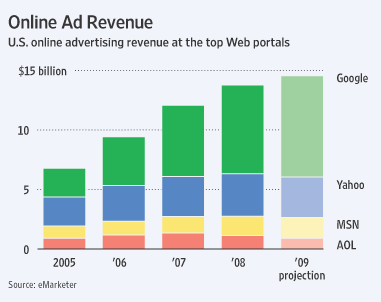
AdAge identifies potential acquirer-ers as “Publicis, Dentsu, WPP, Omnicom, Interpublic and AKQA’s private-equity investor, General Atlantic.” WSJ’s Steele points out conflicts of interest as Microsoft itself advertisers a ton with Interpublic and WPP, and any decision by an agency holding company to align with Microsoft and use its products potentially mean not using Google’s, for example – which might be damaging considering its obvious scale and capabilities. Here’s a graphic from eMarketer on the gap Microsoft is trying to close with Big G:
More analysis from MediaPost on a potential Razorfish/Publicis match here.
Over on Searchbeest, Jonathan Beeston of Efficient Frontier fights for the rights of the algorithm in a lively discussion about automated, bid management platforms and whether or not a human can do a better job with SEM/PPC optimization.
In the spirit of ad exchanges (in our opinion), Minneapolis’ creative agencies have banded together to create value for each other while promoting their city’s talent and expertise in advertising through a website called MinneADpolis. Stuart Elliott of the New York Times quotes Doug Spong, president at Carmichael Lynch, as saying, “If you’re not that familiar with Minneapolis, it’s a market that people can easily discount or overlook. And while people out there can see a lot of our work nationally, there’s some great work that runs only locally or regionally, which can now be seen if they go to the Web site.”
Revenue Magazine looks at Google’s crackdown on certain Google AdWords advertisers. Revenue’s Chris Trayhorn writes, “The precise language that Google is using describes the banned ads as those that “promote a misrepresented affiliation with Google.”
NewMediaAge says that a new report by Institute of Practitioners in Advertising (IPA) in the UK reveals, “Marketers have renewed faith in online display advertising” according to data compiled in a quarterly IPA Bellwether report. Matt Simpson, IPA Digital Group chair told NMA,
“There’s a greater understanding of how everything works together, how display affects the rest of the mix,” he said. “There’s now a far greater requirement for legitimate accountability.”
Finally, in a BusinessWeek article, Forrester CEO George Colony said that he believes CMOs may have cut too deeply in online display advertising and adds, “We believe that this could endanger sales and brands as the economy recovers. Make sure that your marketing team is being judicious, not self-immolating.” Nice one.