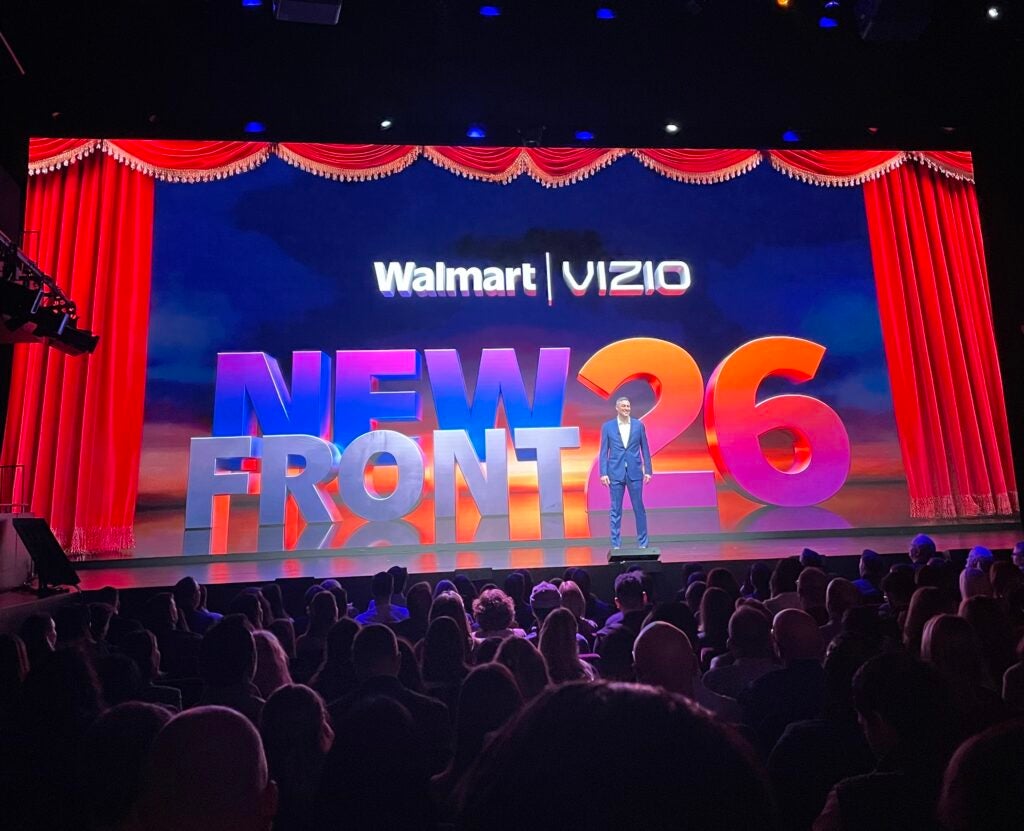
What do you get when you combine the world’s biggest retailer with one of the largest smart-TV makers?
You get yet another NewFront presentation.
On Monday, during their first combined NewFront event as a fully integrated company, Walmart and Vizio execs announced that unified account logins are coming to smart TVs using Vizio’s operating system. The unified login experience establishes a “secure identity framework across devices, connecting streaming engagement directly with retail interaction,” according to the company blog post published early on Monday.
And that identity framework creates a major advertising and data opportunity for advertisers.
By centralizing streaming data within Vizio’s OS, Walmart hopes for a leg up in its battle against Roku, Amazon, Samsung and other streaming distributors that are competing for growth within the overall CTV ad ecosystem.
During last year’s NewFront event, just months after Walmart closed its acquisition of the TV manufacturer, the synergistic growth opportunities were hypothetical, Mike O’Donnell, chief revenue and strategic growth officer at Vizio, told the audience in New York City during the joint presentation.
Back then, the news was “about the potential that had us all excited,” he said. “Today, we’re here to show how that potential has turned into real impact.”
Can you CTV me?
Ever since Walmart began courting Vizio, the ad industry has waited with bated breath for Walmart to combine its shopper data set with Vizio’s streaming and device data to run closed-loop attribution on CTV campaigns.
Today’s announcement about the eventual phase-out of Vizio login credentials in favor of Walmart accounts is one step toward making that vision a reality.
New Vizio TVs now require a Walmart account for activation, while existing Vizio users are prompted to add their Walmart account for an easier time purchasing items (from Walmart, duh) with their remotes. The same rules apply for Onn TVs, a Walmart-owned line of TVs that are now powered by Vizio’s SmartCast OS (and formerly used Roku’s OS).
The OS consolidation follows Vizio operating as a private-label Walmart company as of late last year. With this change, “Vizio’s OS now has the potential to reach 25% to 30% of all US households,” O’Donnell said.
Still, “our value proposition is more than just scale,” he said. After all, in the modern era of “performance TV,” advertisers and media buyers arguably care more about proving a business outcome happened after running an ad than simply reaching a higher total number of people.
To help ad buyers demonstrate performance, “we are connecting retail intelligence with Vizio’s connected TV footprint [so] brands can activate and measure on real shopping behavior,” said Adam Bergman, Vizio’s group VP of advertising and data sales.
What that looks like in practice involves the ability to analyze data from Walmart campaigns across Vizio devices in more granular ways without sacrificing subscriber privacy. Amazon Ads has a similar product, the Amazon Marketing Cloud, where buyers can analyze Amazon’s retail data and streaming media for audience creation – but within a walled garden’s black box.
As seen on CTV
Smart TV-based shopping hasn’t really caught on to the degree that publishers and advertisers have hoped, mainly because people just don’t shop much using TV remote controls. When TV viewers do buy something, they usually make their purchase on a second screen, like a mobile or desktop device.
But owning the TV set does promise potential advantages in terms of interactivity, which Bergman said is the output of successful “content to commerce” for streaming viewers.
Walmart and Vizio are focused on rolling out more interactive ad formats that brands can use to drive higher engagement and (hopefully) sales, including pause ads and home screen activations.
The home screen is an especially important part of Vizio’s strategy (and the strategy of nearly every other smart TV maker’s). There are very few opportunities to get brands, including media and entertainment advertisers marketing other content titles, in front of viewers early in a viewing session. Especially for those viewers who go directly into an ad-free streaming service.
“When you pair ad-supported video with home screen activations, advertisers get big lifts in everything from awareness to purchase intent,” Bergman said.
Even so, marketers understand that TV ads don’t always lead to immediate sales. Sometimes they raise mid-funnel metrics like purchase intent or brand consideration, which lead to sales down the road.
Either way, O’Donnell said, what’s important is “the role TV experiences play in driving business outcomes forward.”
Expect to hear more about streaming TV becoming a performance marketing channel as NewFront week progresses. AdExchanger will be there – stay tuned.