

 Once, E.W. Scripps was a newspaper company.
Now it’s a digital media, broadcast TV, over-the-top (OTT) and podcasting company.
Along the way, it shed its newspapers, which are now part of Journal Communications, and its cable channels, spun off in 2008 into Scripps Networks Interactive.
It also has been acquisitive. E.W. Scripps expanded into podcasting last year via a $50 million acquisition of Midroll Media, followed by the $4.5 million purchase of Stitcher this year. It bought local news OTT platform Newsy for $35 million in 2013 and humor site Cracked for $39 million in April.
With it acquisitions, E.W. Scripps is trying to build a national presence that can speak to all advertisers, not just local ones, and setting itself up for the next media age.
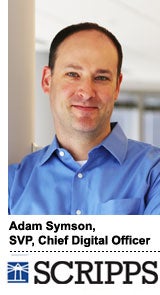
“The key to this company’s longevity is never being done,” said Adam Symson, SVP and chief digital officer.
Plus, as a 140-year-old company, E.W. Scripps behaves differently than the digital media upstarts.
“We run operating businesses,” Symson said, so it steers clear of pre-revenue businesses or those with gobs of investors or high valuations. “There is not going to be an exit once we buy one of those businesses, so we want businesses that have long runways of significant growth ahead.”
Symson talked to AdExchanger about how E.W. Scripps is approaching the digital landscape.

AdExchanger: When you’re at a company where digital is just 6% of overall revenue, what are the benefits? The drawbacks?
ADAM SYMSON: What we are doing today with digital is consistent with the history of the company: leveraging the capital we have today to build the business for the next generation. It’s great to be a part of a bigger business, especially one as robust and healthy as the broadcast TV business.
E.W. Scripps has history over 140 years of never being asleep at the switch. It’s always been about planning for and building new platforms where audiences are developing. When it was doing well with newspapers and broadcasting came on the scene, it was the first to get broadcast licenses. When people said nobody would pay for TV, they developed cable channels.
Why expand into digital from broadcast TV?
We have the opportunity to serve multiple audiences. We can serve our “convergence” audience, which is TV watchers who are equally comfortable going to Roku, online, their phone or Facebook for news. There is an emerging audience of younger consumers who might never watch the 5 o’clock news.
On the other side, we have a collection of growing media brands where we see the highest organic audience growth: OTT video, digital video and TV, podcasting. That is a reaction to understanding the economics of digital. They benefit from scale, and those national businesses can develop new audiences that aren’t constrained by geographic boundaries.
With Newsy and plans for Cracked to have an OTT channel, it seems like Scripps is bullish on OTT.
We love that space in particular. Unlike web and mobile, which have become incredibly democratized, OTT, though still undeveloped, isn’t democratized. Carriage on these platforms requires a contract. They aren’t interested in opening the platforms to everyone. They want to keep it a premium experience. We love working with Sling, Xumo and Watchable. On Newsy, the average session length is 27 minutes. That’s great engagement for a news brand on these platforms.
Given Scripps’ TV focus, that must be advantageous to have that institutional knowledge for doing things like OTT carriage contracts.
This is a reminiscent moment for Scripps. This is the company that created HGTV, the Food Network. While the platforms have changed, building new brands for new platforms is a comfortable place for our company.
Facebook is intensifying its relationship with publishers, from Instant Articles to Facebook Live. What’s the opportunity and threat with the platform?
If you step back from it, Facebook Live might not be as new or different as it seems. Facebook may see itself as the next best content cable system, a content MVPD. It’s a normal thing for publishers to have programming fees for your channel to be on cable. It’s their move to make sure their platform has the most premium content, and they are willing to pay for it. I give them credit for realizing what it’s going to take.
Does the bulk of your digital revenue come from the Newsy and Cracked acquisitions?
Fifty-five percent of our [digital] revenue comes from the local side, where we have been operating for a long time. They spin off strong revenues. We expect to see 20% revenue growth there. On the national side, the other 45%, we’ve told Wall Street we expect to see revenues grow 70%. Those are businesses we’ve acquired or built from scratch.
How is the digital media M&A market out there right now? Are companies overvalued or are prices falling back to earth?
A lot of businesses out there are overvalued. But it depends on your investment thesis. We are cash-on-cash investors. We model it the same for TV and digital. We’ve also been counterintuitive and opportunistic. I tend to shy away from auctions. We tend to look at deals where we get to know the entrepreneurs directly or know how the operate. We look for a match like a marriage. We don’t want deals where the entrepreneurs are mercenary because we are a mission-oriented company. For example, with Midroll, it was Scripps’ commitment to free expression and the First Amendment that helped us beat out the competition.
What’s your assessment of the podcast marketplace? Does viewership exceed monetization right now?
We are in the beginning of its breakout years. You are starting to see a maturation of the way Madison Ave. even views the podcast space. We are now working with big brand advertisers from P&G to Wendy’s and Chipotle, beyond the advertisers that have traditionally been podcast advertisers. The advertising is as in-context as it comes. The medium is perfect for them to find younger, engaged audiences that have been difficult to connect with. With Midroll and Stitcher, we think we are really well positioned as the big fish in the smallish sea to lead the industry as the sea expands.
But on podcasting, measurement is a bit lagging right now, correct?
I think there will be normal maturing of the space to help answer those questions. But at the same time, podcasting as a medium cut its teeth on direct-response, and those advertisers are incredibly focused on efficiency. There is not a lot of waste. When we talk to advertisers, they clamor for bigger and bigger buys. If you look at our return rate for advertisers, you get the sense that there is a broad and universal belief that the advertising works.
Does E.W. Scripps subscribe to the barbell strategy, where programmatic is at one end and sponsored content at the other?
We do native and sponsored content in all our business. We see more scale on the national side, where Cracked and Newsy are in the funnel for agency RFPs and direct-sold native advertising. What we loved about Cracked when we were doing research about the acquisition and the space we want to be in is that humor and satire are the lens through which millennials view the world, and that’s the same for brands. Cracked is a terrific platform for that.
If digital display advertising is becoming commoditized, how are you dealing with that reality?
A big chunk of our revenue is display. In the local markets, we operate in a somewhat protected way. We are the local advertisers’ trusted media consultants and have been for years. All national advertising has gone programmatic; we’ve been extremely aggressive and progressive. We are setting up private exchanges and doing deals with agencies and brands to open up our inventory programmatically. We’ve seen CPMs grow 250% from three to four years ago versus today as the result of not trying to stave off or keep out what’s happening, but instead having a seat at the table.
This interview has been condensed and edited.








