 Facebook is already an important player in the attribution space, partly by virtue of its ability to do multi-device impression analysis, linking ads served on mobile and desktop to conversions that happen off-site and increasingly, offline. It has no need for cookies, the stock-in-trade of most attribution platforms, since all impressions tie back to Facebook’s user ID.
Some recent moves and hints by Facebook suggest the company is moving fast to advance its attribution system.
For instance, this week it’s rolling out a conversion tracking and optimization system designed to link online conversions back to Facebook ads served along the consumer media journey. The system then uses an audience clustering algorithm it calls Optimized CPM (OCPM) to identify users likely to take an action specified by the advertiser – for instance, registrations, purchases, or email signups. (Facebook blog post)
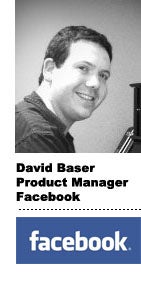
Looking beyond tracking online conversions, Product Manager David Baser tells AdExchanger the company will eventually let ad buyers track organic impressions – including owned and earned media. “We know we have to offer something there eventually,” he says. More on that in the Q&A below.

Using the new conversion tracking & optimization tools, Facebook says Fab.com lowered its cost per acquisition by 39%. And a political organization, the Democratic Governors Association, saw cost per conversion that was 85% lower than its previous online campaigns. Across all campaigns in the beta, Facebook says when the Conversion Measurement system is used alongside its black box OCPM algorithm, cost per conversion falls by 40% on average compared to CPC campaigns with the same budget.
Rob Leathern, CEO of Optim.al Social, says the rollout points to Facebook’s future beyond its own properties. “Since it allows marketers to get the benefit of their machine learning on the back end without thinking about targeting explicitly, it gets them closer to building a system that can push beyond the walls of Facebook’s own publisher properties out further across the web and mobile web,” he said.
Facebook’s David Baser spoke with AdExchanger yesterday.
AdExchanger: What is Facebook doing in cross-device attribution?
DAVID BASER: Just as with all other conversion measurement systems out there, we provide advertisers with a snippet of code for their websites. That snippet generates a ping when a user takes a desired action.
The key difference is that other conversion measurement systems rely on dropping cookies on the users when they see or click on the ad. We understand who the user is regardless of whether they’re logged into Facebook on the app or on the mobile phone.
When that ping comes back from a user taking an action on the customer’s website, we associate that back to the user ID without relying on a cookie ID.
Once we have this system based on user IDs and not based on cookies, we can use it to have consistent attribution across web, mobile and even multi-browser on the desktop.
If an ad shown on the mobile newsfeed says “Check out our website” and [the site] is not optimized for mobile, even if a user goes next day or next week, an attribution will be assigned regardless of the where ad is shown.
What’s the attribution roadmap at FB?
Right now our primary focus is on two things. One is getting the measurement system adopted as widely as possible, and two is providing high quality optimization based on measurement.
Over time we think it will be incredibly important that across all advertising systems, we have more consistent systems for attribution and measurement. And that we not get confused when a user is using a mobile device or switching between desktop and tablet.
We’re trying to lead the way in our thinking, and over time create a more effective attribution system that will work for the whole ecosystem across landline and mobile.
What about impression tracking for organic content on Facebook, both owned and earned? Do you plan to offer that?
Let me acknowledge that we understand measuring conversions on organic content is very important. At this time we’re still trying to assess our options. It’s a little early for us to provide our own solution, and we don’t currently provide any third party solution.
We do understand that’s very important. We know we have to offer something there eventually.
How much are you ramping up the system with the global launch of Conversion Measurement and Optimized CPM?
Up until now we’ve been working with clients one-to-one to include them in the beta. That’s limited us to the low hundreds of clients. Now we expect to scale rapidly. The system is now available to all advertisers, in all countries and languages.
With anything that requires code changes to a website, it will take sometime before all advertisers can ramp up.
Could you talk more about how it works?
We create aggregated and anonymized clusters of users. Any time a user takes any kind of action on Facebook or on an advertiser’s website where the pixel is installed, that action feeds back into these aggregated clusters. We create those aggregated clusters based on all the signals we get over time based on connections and actions on Facebook and off Facebook.
Using that we try to understand what kind of characteristics make someone likely to take a certain type of action. When [an advertiser] specifies a desired action – say registration or purchase – we look for users more likely to take that action. We shift the advertising to that segment.
It lets advertisers looks at the delivery system in an automated way, it’s an improvement on trying to calculate CPC or optimize manually.