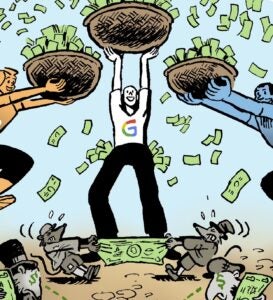
In 2020, the term for “made for advertising” didn’t exist.
The arbitrage sites, whose sole function is to cynically manipulate search engines and programmatic tech to generate ad revenue for worthless pages, accounted for about 5% of all open web auctions.
By 2021, MFA sites, as they’d come to be called that year, had ticked up to 15% of the ad-supported web. Then it was 20% in 2022.
By the middle of this year, MFA sites were gobbling up 30% of ad auctions, and this “gradual boil” now has the entire industry in a state of emergency, said Chris Kane, president and founder of ad research firm Jounce Media, at AdExchanger’s Programmatic IO event in New York City last week.
“The supply grows because the demand continues to exist,” Kane said.
The good, the bad and the ugly
MFA sites present an interesting conundrum – and a great future business school case study.
On one hand, they aren’t fraudulent. Unlike bot farms and site operators that manipulate the browser window and straight up defraud advertisers to steal their money, MFA sites have valid human traffic.
In fact, as Kane noted, these site publishers are actually responding directly to what advertisers are telling them they want: cheap, viewable impressions placed in front of valid human traffic. The content is garbage and the layout is jampacked with horrible ad units, but MFA sites put ad tech in the uncomfortable position of playing judge and jury.
When AppNexus began dealing with ad fraud in 2014 and 2015, then-CEO Brian O’Kelley stressed the difference between fraudulent sites that sell bot traffic for CPMs and, say, mobile apps that have a tiny “X” to close a video ad. Those are terrible formats people hate, but they aren’t fraudulent.
Programmatic tech likes hard-and-fast rules because rules can be plugged into a system that’s automated and optimized. Moral or legal gray zones where the ad system must make subjective decisions about what’s right and wrong are very much not the forte of programmatic companies.
It should stop, though
There is, however, a sympathetic view of MFA site operators. If you squint hard enough.
“These are publishers that were told to hit certain KPIs [i.e., brand-safe, viewable impressions with invalid traffic detection] and, even just a few weeks ago, were told they were important partners for many of these SSPs,” Kane said.
Suddenly – the ANA’s recent programmatic transparency report had a little something to do with this – these sites are finding themselves blocked and derided by those same SSPs.
It’s hard to feel bad, though. Most aren’t literally fraudulent, but MFA site operators have collectively earned hundreds of millions of dollars while knowing full well they deliver zero real value to advertisers.
And many MFA site operators do have a guilty conscience. While investigating MFA supply, Jounce found that many remove ads when people visit directly, but flood the page when people come via social media, search engines or content recommendation widgets like Outbrain or Taboola.
What’s that about? Well, the answer is likely that the only people who go directly to an MFA URL are from Jounce and doing MFA counter-research or are inventory quality workers at an ad tech company.
This discovery was a critical moment for Jounce, Kane said, in revealing that MFA sites are culpable. These site networks are, in fact, knowingly taking advantage of advertisers.
MFA sites also keep moving with their site names, so they’re tough targets for programmatic tech built on blocklists.
The top 150 MFA sites in the world right now, per Jounce’s tracking, didn’t exist a few months ago, Kane said. Check back again next month, and most of those sites will be replaced with new URLs.
What can be done?
What makes the MFA economy such an interesting case study is that it is a pure example of the power of market dynamics and incentives to usurp responsibility and good sense.
For instance, ad fraud is perpetrated by sophisticated criminal organizations and to combat fraud requires a collaboration of anti-fraud stakeholders. At a baseline level, companies like Human Security or Confiant must work with an infrastructure service, such as Google Cloud, Microsoft Azure or Cloudflare, while looping in the DOJ or FBI to get warrants.
But combating MFA requires almost no sophistication or technical lift. The amount of MFA revenue on the open web at any point is “directly correlated to the amount of dumb money” spent on programmatic, Kane said.
The only reason agencies, ad tech vendors and publishers don’t put the kibosh on MFA en masse is that the demand exists. Advertisers tell their automated system they want cheap, viewable inventory and receive MFA supply that fits the bill exactly.
Although the site URLs change constantly, ad tech could just block the network seller rather than try to block each MFA site one at a time.
In fact, most major SSPs have committed to providing zero MFA inventory in private marketplaces. In other words, Kane said, when those SSPs represent the buyer’s interests, they won’t supply MFA.
But when a DSP ostensibly reps the buyer and tells SSPs through the language of openRTB that they want MFA – which is to say, they bid for cheap, viewable, valid human traffic – almost all SSPs will meet the demand. (Only TrustX, which represents larger digital media and newspaper publishers, and Kargo have committed to trafficking zero MFA supply, according to Kane.)
Which goes to show that the ad tech ecosystem could simply flip a switch and get rid of all MFA.
Through the worst of it
On the plus side, MFA supply likely peaked at 30% of open web auctions this summer, Kane said – although ad tech researchers were disappointed previously, when there was a huge dropoff in MFA revenue in early 2022 following research and press reports.
But that dip, Kane said, that was also due to market dynamics at work. In Q4, when advertisers have more money and are eager to spend it, that money naturally finds its way to MFA supply.
In January, when marketers reset their budgets, “the arbitrage opportunity is thin,” Kane said, so MFA sites go quiet.
“I’m not quite ready to call it the top,” Kane said, but the month-over-month declines in revenue since June are new. MFA trend lines usually go up over the course of the year.
Still, in Q4, when dumb money is rich again, it will spend on MFA. But perhaps – hopefully – Q4 2023 won’t reach the 30% peak. That said, the US presidential elections next year might serve to inflate MFA supply if political buyers don’t put more exacting rules in place to govern their programmatic spend.
“When marketers tell DSPs to optimize by sales, conversions and real-world outcomes, they run away from MFA,” Kane said. “When DSPs are told to value cost per viewable impressions, they gobble up MFA.”