
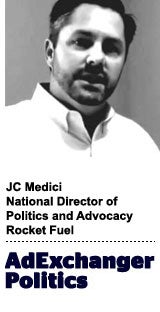
 “AdExchanger Politics” is a weekly column tracking developments in the 2016 political campaign cycle.
Today’s column is written by JC Medici, national director of politics and advocacy at Rocket Fuel.
Disagreement inside political party lines is nothing new. Someone is always on the outside, such as Reagan and Ford’s neck-to-neck battle for the Republican nomination in 1976 and the strained Gore-Clinton relationship in the ‘90s. Yet, despite disagreement, campaign messages were ultimately controlled within the parties and some form of consistency existed.
Looking at the 2016 campaign trail, it has not been without its disagreements on both sides of the aisle. Even now as parties recently announced their presidential candidates at their respective conventions, not everyone has come back to the center. However, this is the first time we’ve had an audience as engaged through social media and digital advertising. This caused the conventions to lose control of some of the overall messaging that they’d previously held so dear.
Digital is giving control to the candidates outside of traditional media. Previously, there was no vehicle to communicate directly with voters without necessarily running all messages along party lines or spending tons of money on TV to speak directly with the American people as Ross Perot did in 1992. But the old rules of running 90% spend on direct mail and TV have gone out the window and it’s necessary to start looking at media mixes based on audience and mobilizing people in new ways.

Trump didn’t run a single TV ad and dominated the GOP nominating process. On the left, Bernie Sanders and his social media-driven campaign raised more than $200 million in the last year, keeping him on par or sometimes ahead of Hillary Clinton and her more traditional revenue-generating strategy.
Even if political parties align the right candidate with the right message, it is becoming increasingly hard for them to keep control of the narrative. Because of this, we can expect to see more open discussion, unified media plans, unfading moments and other unique developments in the future as campaigns leverage digital to mobilize voters directly and efficiently.
More Open Discussion And Narratives
Traditional TV campaigns are costly, and messages on this platform typically need to be succinct and selective. Social media has opened the doors for candidates to expand their messages and have a more open dialogue about new issues and narratives. Parties need to be open to these diverse discussions to maintain a resemblance of control.
Take TPP for example. Trade, a topic no one usually campaigns on in-depth, has become a sexy topic this year. Trump and Sanders both campaigned on TPP, but the real conversation was held outside of the media, through social and digital channels instead.
Unified Media Plans
It will become easier and easier to have unified media plans, which are necessary for campaigns to start analyzing online and offline touchpoints. This is important for online to become that glue that merges traditional advertising, such as TV and direct mail, with digital so that we have a more holistic 360-degree view of voters and engage in more meaningful interactions.
Individual Positions Stemming From Party Lines
Outside of the unique cases we’ve seen this year, most everything is still run by the parties. Everyone and everything is vetted and stepping out of line with the party may leave a candidate without money, backing or any voice at all.
Digital will provide a better way for people to communicate their unique platforms publicly and create a more open forum for voters to voice their opinions on who should be the right candidate. Candidates will largely stay within party lines, but they will have the ability to create and communicate their own nuanced positions.
A Change In Media Valuation
People are acknowledging the impact that digital and social media are having on both sides of the scale this time around. However, those disruptions don’t lead to an instant monumental shift. We won’t immediately see massive amounts of digital integration resulting from either convention, but there is already a huge shift in the perception of digital campaigns. It may start small in 2018 with a change in media valuation and scale into a bigger concept entering the 2020 election cycle.
Unfading Movements
Associating the energy of the candidates with the energy of the party is a thing of the past. Movements will not die after a candidate’s run or campaign. With new tools of digital communication, movements will continue to grow and breathe life long after an election. Mobilization for something people believe in is now very easy to do, which is why we’ll see a continuation of this like we’ve never seen before.
What is happening with digital and the way candidates are controlling their own messages through digital is not an anomaly. The evidence is irrefutable on both sides of the aisle, but if we all work together, we can make digital a fruitful technology for candidates, conventions and voters alike.
Follow JC Medici (@JCMedici), Rocket Fuel (@rocketfuelinc) and AdExchanger (@adexchanger) on Twitter.









