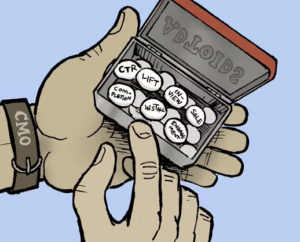

Content recommendation doesn’t have the best reputation. The word “chumbox” often gets tossed around.
But Outbrain is out to prove that its ads can drive awareness with its launch on Wednesday of an attention-based offering that could change its monetization model.
The new platform, called Onyx, gives brands a way to measure their return on investment in awareness campaigns by tracking whether people are actually paying attention to their ads.
After years of courting lower-funnel performance budgets – and charging on a cost-per-click (CPC) basis – Outbrain foresees further growth in attracting upper-funnel spend, said co-CEO David Kostman. So it’s looking to capitalize on the growing demand for attention-based reporting and measurement from brand buyers, especially for upper-funnel awareness and consideration campaigns, he said.
And Onyx’s CPM-based pricing represents such a departure from Outbrain’s current model that the company is marketing Onyx as a new sub-brand rather than as an extension of its existing platform.

Contextual targeting
Onyx allows brands to buy video and display placements that appear in the middle and end of articles from Outbrain’s network of publisher partners, including CNN, Fox News and Dotdash Meredith.
The display aspect of the solution will focus on what Outbrain calls “high-impact” display ads, meaning ads that contain some interactive element rather than static images.
The platform is really designed for pre-roll video, though.
Outbrain has been building its video advertising capabilities for years, Kostman said. Outbrain’s acquisition of Swiss contextual video company Video Intelligence in 2022 helped set the stage for Onyx’s debut.
Using Onyx, advertisers can target their campaigns to run alongside contextually relevant content. Outbrain categorizes publisher inventory into interest-based segments by analyzing the text or video on the page. These contextual segments can be further enriched through propensity modeling, which projects which audiences will be attracted to a piece of content according to Outbrain’s content recommendation algorithms.
Onyx ad placements are available programmatically through Outbrain’s DSP partners. Outbrain expects that the primary method of activation will be private marketplace deals. But the platform also supports buying through direct insertion orders as well.
A new revenue model
As a publicly traded company, Outbrain is beholden to investor expectations for continued revenue growth, which is part of the motivation behind the company’s new focus on awareness campaigns and video placements.
“Awareness and consideration budgets are bigger than performance budgets generally, and video is a fast-growing [channel],” Kostman said. “When you combine these two, it increases our addressable market significantly.”
Because Onyx is designed for upper-funnel awareness campaigns, the platform will use an impression-based CPM pricing model instead of CPC, which has historically been Outbrain’s bread and butter. (Outbrain’s other ad products will still charge on a cost-per-click basis.)
Attention measurement
But it’s one thing to sell based on attention. You’ve also got to measure it.
Outbrain is partnering with attention metrics startup Adelaide on post-campaign measurement and optimization for Onyx placements.
To determine how likely people are to pay attention to an ad, Adelaide analyzes an AI-modeled combination of eye-tracking panel study data and proxy attention signals, such as dwell time, scroll depth and cursor hover time.
While Onyx advertisers will only get post-campaign attention measurement to start, Outbrain plans to build in the ability for deals to be transacted on the platform using Adelaide’s proprietary AU metric as a currency “in the not very distant future,” Kostman said.
The safety dance
In addition to measuring attention, Outbrain also needs to reassure advertisers on the brand safety front – and brand safety can be tricky for Outbrain, which tends to mostly work with news publishers.
Many advertisers consider news content to be inherently brand unsafe, and they use brand safety solutions to block news from their programmatic ad buys.
Outbrain will not block news content from the Onyx platform by default, Kostman said. Rather, the platform will honor the existing brand safety parameters an advertiser has set up with DoubleVerify.
That means, if a brand does block all news content, it won’t be able to buy Outbrain’s news inventory. If a brand only blocks certain news content, however, then only those categories will be excluded.
Early results
Onyx is now generally available in the US, UK, Germany, France and Italy. Launch partners include Ford, which is buying Onyx inventory through the Xaxis DSP.
During beta testing, Onyx ad placements outperformed Adelaide’s AU benchmarks for display and rich media formats on all device types by 26%.
The scores for mobile ads, which represent the majority (66% in 2022) of Outbrain’s business, were 53% higher than Adelaide’s benchmark for mobile banners and 20% higher than its benchmark for mobile rich media formats.
Perhaps counterintuitively, ads that appear at the end of articles tend to garner higher attention scores than those in the middle of articles, Kostman said — however, more data is needed to definitively prove this hypothesis.
End-of-article ads likely garner higher attention scores, he added, because placing ads at the end of articles is less interruptive and readers see the ads at a point in time when they are open to suggestions for what to check out next.
As for what’s next for Outbrain, the company plans to adjust the pricing for its ad inventory using Adelaide’s attention metrics, Kostman said.
So, don’t be surprised if Outbrain starts charging a premium for those end-of-article placements.