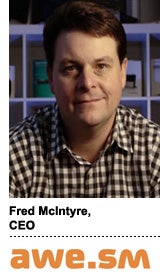
 Fred McIntyre, CEO of social marketing platform Awe.sm, has noticed that while the present-day patterns of media consumption are exciting, they also pose challenges to the DNA of cost planning for publishers and marketers.
“If you look at media consumption across most categories in television, radio, online and social, they’re going up in each category,” he said. “As that happens, the engagement, the fundamental unit of currency in media, gets subdivided and subdivided. At the same time that’s happened, the amount of money that moves into media essentially grows at the rate of inflation.”
Media companies thinking about how to reach and engage an audience, where McIntyre hung his hat for more than 20 years in leadership roles at AOL and CBSi, “have to really think deeply about what this tectonic shift in engagement patterns means to [their] business.” This entails determining the value of each audience engagement and how to preserve the value of the media that’s being sold.
“People are consuming so much more and the supply is growing at such a great rate that the amount of money to pay for all that supply is growing at a much slower rate,” he said. “On the publisher side, that’s a key challenge and you have to think about your cost structure there. This is why AOL continues to make exchange-based investments, which they’ve been focused on since they bought Ad.com.”

But marketers buying media programmatically also have an interest in its value. Often, they must consider in which cases will they pay a premium to engage in publisher-direct, and the extent to which their direct engagement with consumers helps them control their own image and branding.
McIntyre describes this as the promise of social in driving one-to-one, personalized conversations with customers, and the interplay between the push and pull in marketing is “one of the most fascinating things” about the business today.
One reason McIntyre moved to Awe.sm last May is because he saw social’s evolution as a branding and awareness apparatus into one that drives measurable conversion and attributable ROI. As both Facebook and Twitter move past proxy metrics, and add features like deep, CRM audience matching and lead-generation capabilities, social media will continue to evolve.
“Being able to connect with a user in a social context is a great opportunity to drive them to a specific conversion,” McIntyre said. “At Awe.sm, we have a closed-loop system that’s optimized for a digital context. … We create specific tracking links that go along with shares, whether they are generated by users or shares coming from social media managers at agencies and then connect that activity to specific conversion events at a publisher destination.”
BMW, for instance, uses Awe.sm’s unique tracking links that are tailored for actions all the way down the funnel. They are able to determine if people clicked on a link, where and how they visited BMW’s car configurator site and whether or not they did a dealer search and scheduled an appointment. Once a prospect gets to a certain point in the funnel where BMW knows there’s a one-in-three chance she’ll turn into a purchaser, according to McIntyre, BMW ties the interaction in through multichannel attribution.
McIntyre looks at Awe.sm as a part of the broader multichannel attribution story.
“There’s this ‘higher order’ of multichannel attribution, which a lot of the consumer packaged-goods companies do,” he said. CPGs want to know, within their entire mix – including video ads, TV ads, radio spots – which were responsible for driving a purchase of a certain product. “In that context, I think we provide higher-quality input data for people doing that. The quality of the last-mile attribution we’re able to solve for in a digital, social context, will have a direct impact on the multichannel understanding people are investing in.”