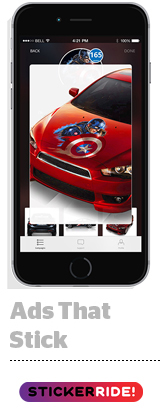
 When StickerRide talks about driving impressions, the word “driving” is literal.
The Moscow-based startup, which launched in the US on Tuesday, offers a platform that enables the drivers of private cars to turn the sides of their vehicle into ad space. It’s a bit like outdoor on the go.
US CEO Christian T. Lundgren describes it as a sort of gamified version of Uber or Lyft without the passengers.
Brands select the neighborhoods that best align with the desired target audience for whatever campaign they’re running, not unlike the way an advertiser buys traditional out-of-home, and designates how many drivers they’re looking for to penetrate a particular area, as well as when and for how long. Advertisers can tweak the campaign parameters through a web-based dashboard whenever they want.
Drivers then use the StickerRide app to sign up for the campaigns they’re interested in.
When a match has been made, drivers are sent to an installation facility where a branded decal is placed on their car for the duration of the campaign. Drivers earn points no matter where they drive, but they earn the most points when they drive in the designated areas at the designated times.
To earn extra points, drivers can also participate in quests and flash mobs if, for example, a brand is looking for more exposure at a certain intersection or near a certain nightclub. Drivers are encouraged to sign up for brands they like because it makes them more likely to engage in the activities.
All their movements are tracked by the app, and at the end of the campaign drivers get a payout based on their activity. Although the amount depends on how much driving they do, the average user can make several hundred dollars a month.

The twist is that brands can effectively buy eye-level media in places where OOH space doesn’t exist, like stretches of the Pacific Coast Highway or, say, a mall in Staten Island with a movie theater. It’s also cheaper than buying a billboard or bus shelter advertising.
It sounds gimmicky, but StickerRide claims more than 40,000 active drivers worldwide and it’s done work for the likes of Gillette, Marvel and the fourth (will it never end?) installment of Paramount’s “Transformer” series.
B&N Bank, a large federal bank in Russia, has been using StickerRide to augment its other marketing efforts for more than a year.
It “allows us to optimize costs when compared to classic outdoor advertising on transport and to increase coverage compared to stationary billboards,” said Mikhail Semikov, B&N Bank’s head of marketing. “For us, it was important to pay only for vehicles in a certain area to attract customers around our offices [and the] tracking system helps us adjust the campaign planning and to increase the density of contact with the brand in the selected areas.”
Although the concept of sticking branded decals on cars isn’t new, the level of accountability that mobile brings is. “Tracking through the app is what allows this whole thing to work,” Lundgren said.
StickerRide is also making a push around measurement. The company is working with TAB (Traffic Audit Bureau), the industry body that provides a standard measurement and metrics service for out-of-home media, to develop an impression reporting system for the StickerRide tech.
All in all, it’s just another way to try and break through the clutter with, admittedly, a bit more clutter. But brands like B&N Bank have seen success.
“Of course, this is not our main channel, but with its help we complete our mix of media, which consists of TV, internet, outdoor advertising and radio,” said Semikov, noting that B&N has reduced the amount of traditional outdoor it buys, replacing it with StickerRide media. “The influx of new customers indirectly confirms the positive experience of using this media channel for us.”
Founded in 2013, StickerRide has its global headquarters in Moscow and offices in London, Paris and Los Angeles. The company has roughly 100 employees and raised $3 million in seed funding from Winter Capital at the end of May.