 Mobile web notifications are blurring the line between apps and the mobile browser.
For publishers without apps, mobile web push is a way to interact with people in an app-like fashion. And publishers with an app can use web push to communicate with users even if they haven’t downloaded it.
According to numbers released by Google at the Chrome Dev Summit on Thursday in San Francisco, 18 billion web push notifications are sent daily across 50,000 domains, including Facebook, LinkedIn, Twitter, eBay and Gmail.
There’s been a “broad and accelerating shift to mobile platforms where elements of the mobile user experience, like notifications, are becoming ubiquitous across more types of platforms and devices,” said Mike Herrick, SVP of product and engineering at Urban Airship.
The Android Way
Google in particular has been throwing its weight behind initiatives that bring greater parity between apps and the web, like Android Instant Apps, which lets users stream app content without having to install an app; allowing apps to show up in search results; and enabling web push on Chrome for Android, which gives mobile web push experiences a decidedly app-like feel sans the actual app. (Google didn’t respond to an interview request.)

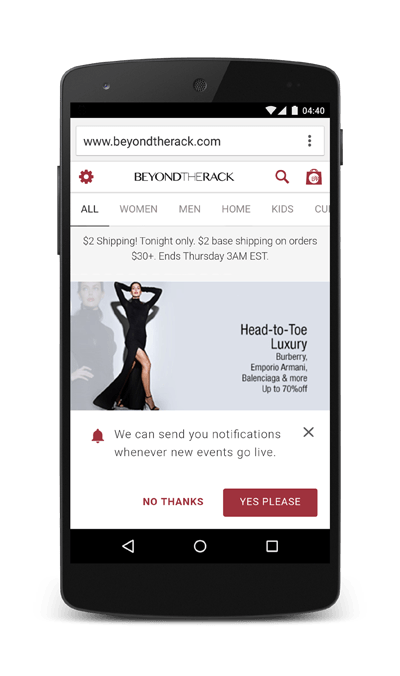 It’s part of a collective effort from Google in Chrome and Mozilla in Firefox around the notion of “progressive web apps,” defined by the Mozilla Developer Network as the boxer briefs of web development – “taking standard websites/apps that enjoy all the best parts of the web, such as discoverability via search engines, being linkable via URLs and working across multiple form factors and supercharging them with modern APIs … and features that confer other benefits more commonly attributed to native apps.” That description includes push.
“Lots of people visit a news publisher, for example – they read a great story, they enjoy it, but even at that point they’re still quite a few steps away from going to an app store and downloading an app,” said George Deglin, CEO of OneSignal, a push notification startup that lets developers send personalized notifications across platforms, including apps, the web and the mobile web.
But publishers still want to re-engage those readers.
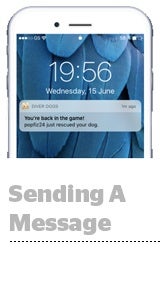
There are myriad use cases for mobile web push: a notification to join a live stream, push to say that a sale is about to begin or end, or that your package was sent, is en route or was just delivered, a message to alert you that your favorite designer is now in stock.
Those are all transactional examples, but “taking away that requirement to download and the ability to directly message users who don’t install an app [is] going to be a particular boon to newspaper publishers,” said former MoPub and Twitter exec Kevin Weatherman, who joined OneSignal as VP of business development in September.
Rather than pushing every time a story posts, publishers can get creative with their re-engagement strategies. For example, OneSignal is in the midst of running tests with a celebrity news site that wants to tag individual celebrities rather than topics so its readers can stay in the loop about Taylor Swift without ever having to hear about Katy Perry.
 The Apple Way
While Google and Mozilla and taking an open web approach, Apple allows Safari web push on desktop, but not on the mobile web.
That’s by design, Deglin said. Apple wants people to download apps because the App Store has been a cash cow, with more than 100 billion apps downloaded since 2008 when the store first launched.
Apple’s contribution to cross-platform notifications has largely been cosmetic. As part of its recent iOS 10 release, Apple rolled out rich notifications that allow developers to jazz up their push with images, GIFs, video and audio.
Last week, millennial news publisher Mic began using rich notifications in iOS 10 powered by OneSignal, which lets users play videos and preview stories directly on their lock screen.
“Mic has taken a POV that push and the low-friction consumption it enables will be the next major format for news,” said Mic’s chief strategy officer, Cory Haik. “Along with the engaging visual, the goal of our app is to provide awareness. … Personalized, rich notifications is exactly the right platform because it allows us to give the user news they actually care about, fast.”
Notifications play a central role in Mic’s engagement strategy.
“The heart of notifications is entertainment with information [and] the design must mirror that, but interaction is key,” Haik said. “Direct-to-consumer channels are a very meaningful way to connect with our audience and we see this highly visual, mobile-first storytelling format as a powerful part of the future of news.”