

 Putting the “A” in MAU or DAU is about a lot more than enabling users to rack up a bunch of points – it’s about giving those monthly or daily users a reason to be active in the first place.
“Customer loyalty is at the heart of everything we do,” said Karah Sutton, marketing and advertising manager at PikPok, the New Zealand-based mobile game studio responsible for Oreo: Twist, Lick, Dunk!, a branded app developed for Mondelēz in 2012 that spent time at No. 1 in Apple’s App Store.
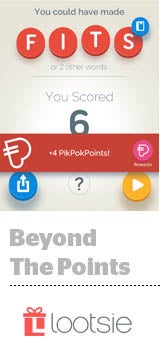
PikPok wants players to revisit its games, and the studio has been experimenting with an API-based white label loyalty solution that was developed and licensed by in-app loyalty tech company Lootsie. PikPok is using the product as the framework underpinning the loyalty program for its word game app, Four Letters.
Lootsie’s product, which came out of beta on Monday, aims to provide app developers with the backend engine to power their loyalty programs.
Devs can customize the platform to fit the native look and feel of their own app, set their own achievements and name their own currency, while at the same time taking advantage of Lootsie’s reward marketplace, where users can spend their points on whichever prizes they choose.
Lootsie cultivates and maintains relationships with around 70 brands, including Solé Bicycles, audio equipment company Sol Republic and beauty subscription service Beautybox, which provide products to populate the marketplace. Another 50 or so brands are in the pipeline for the end of Q4.

“Offering real-world rewards gives a reason for players to revisit our games and play over a long period of time, in addition to the enjoyment of the game itself and the in-game achievements,” Sutton said.
The purpose of a loyalty program isn’t to change a user’s behavior, said Lootsie president and co-founder Brandon Werber. It’s about rewarding people for the things they already do – and encouraging them to do those things a bit more.
“In the case of a fitness app, for example, that means inspiring people to go the extra mile, not getting them to start running in the first place,” said Werber.
It’s an important distinction. The goal is to reward loyal users – not attract users who are only in it for the reward.
And that’s where the data comes in. Lootsie tracks user behavior to suss out preferences based on what an individual person likes combined with the fruits of an Amazon-inspired algorithm that examines the behavior and preferences of similar users.
Developers can tap into that data to suggest relevant rewards after users fulfill specific achievements – say, wireless earbuds as kudos for the completion of 20 workouts.
They can also take advantage of that data to optimize app usage. If a game offers users 10 points for each completed level, but it turns out that most users churn after Level 4, the developer could tweak the rewards structure to offer 100 points just for the completion of Level 5. A strategic incentive.
Several of Lootsie’s launch partners, including PikPok, are planning to deploy Lootsie across multiple titles in their portfolio and make points portable and redeemable among several of their apps.
 “This is rewarding for the players because they can earn points more quickly, and it will hopefully introduce them to some of our other titles that they might not have noticed otherwise,” Sutton said.
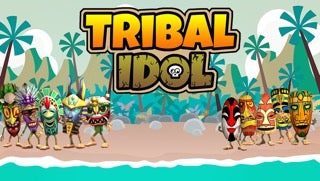
Social gaming company Bonanza Media plans to do the same, starting with 3-D puzzle game Tribal Idol as well as Shrek, an animated slots-themed game created as a joint venture with DreamWorks.
It’s cross-promotion meets retention, said Bonanza CEO Chris Hewish, who said he’s careful to keep the loyalty economy in his apps separate from core monetization tactics like in-app purchases. Bonanza points are doled out solely in return for time spent inside its apps.
“That allows us to appeal to people who aren’t necessarily spending money, so that we can retain them longer and monetize them through advertising,” said Hewish, who spent six years as head of global interactive at DreamWorks Animation before moving over to Bonanza in 2014.
In many ways, Lootsie is positioning itself as an alternative to advertising.
“We want to help advertisers create a more elegant loyalty experience without having to pollute the app they created with all kinds of noise and advertising,” said Lootsie CEO and co-founder Marc Mitchell. “And we want to give users choice in the brands they interact with, rather than just forcing something on them as a one-off.”
Headquartered in Los Angeles, Lootsie has raised $4.75 million since it was founded in 2012, including, most recently, a $3.5 million in seed funding in January.







