Imagine that everywhere you look, you’re bombarded with ads for the same brand. Massive out-of-home ads downtown. Homepage takeovers on every major news site. Takeovers on Instagram pages.
And then, 48 hours later, poof, the blitz is over.
This might sound like a fever dream. But actually, that’s how Canadian CPG company Maple Leaf Foods launched the first phase of its “Look for the Leaf” Campaign in March, as financial uncertainty and frustration were on the rise after the announcement of US tariffs.

The purpose of the campaign, in partnership with creative agency Fuse Create, was to emphasize Canadian pride by encouraging grocery shoppers across Canada to literally “look for the leaf” and buy products featuring the maple leaf icon that designates Canadian brands.
The second phase of the campaign, which launched at the end of June and is primarily running nationwide OOH ads, plus extended reach on news sites, will run through the end of July.
There’s no ‘I’ in ‘Canada’
Since US tariffs went into effect in February, it’s been a major talking point on Canadian news sites, according to Luke Moore, Fuse Create’s VP and managing director of media.
Industries, including steel and automotive, have seen major slowdowns, Moore said, triggering a wave of patriotism influencing where Canadians want to spend their money.
Maple Leaf Foods set out to orchestrate “a cultural event, not just a campaign,” Moore told AdExchanger. It seized on the sociopolitical moment to foster unity, rather than competition by bringing attention to all Canadian products, not just its own.
The campaign creative during both phases was consistent across the country and targeted grocery shoppers in both English and French. It ran across digital out-of-home, digital media and print ads.
Running a campaign for only two days isn’t the norm in advertising. But Maple Leaf Foods “wanted something unorthodox and disruptive,” he said.
And what’s more disruptive than a nationwide takeover?
Just a quickie
The strategy wasn’t just unique; it was effective. In those 48 hours, Moore said, the campaign reached two-thirds of Canadian grocery shoppers.
Almost all of its digital buy was made directly with Canadian news publishers. Only 5% was programmatic display, Moore said, “to help fill the news targeting void.”
Although the “media flood,” as Moore referred to it, only lasted for 48 hours, Maple Leaf Foods advertised at an enormous scale within that brief window. The brand took over most of the large digital billboards in Sankofa Square in Toronto, dominated ad space in the Food & Beverage and News & Education sections of Reddit and took over the front page of major news sites.
During this phase, the out-of-home ads were placed on “large-impact, mega-size screens” at just two major destination points in Toronto: Sankofa Square and Union Station.
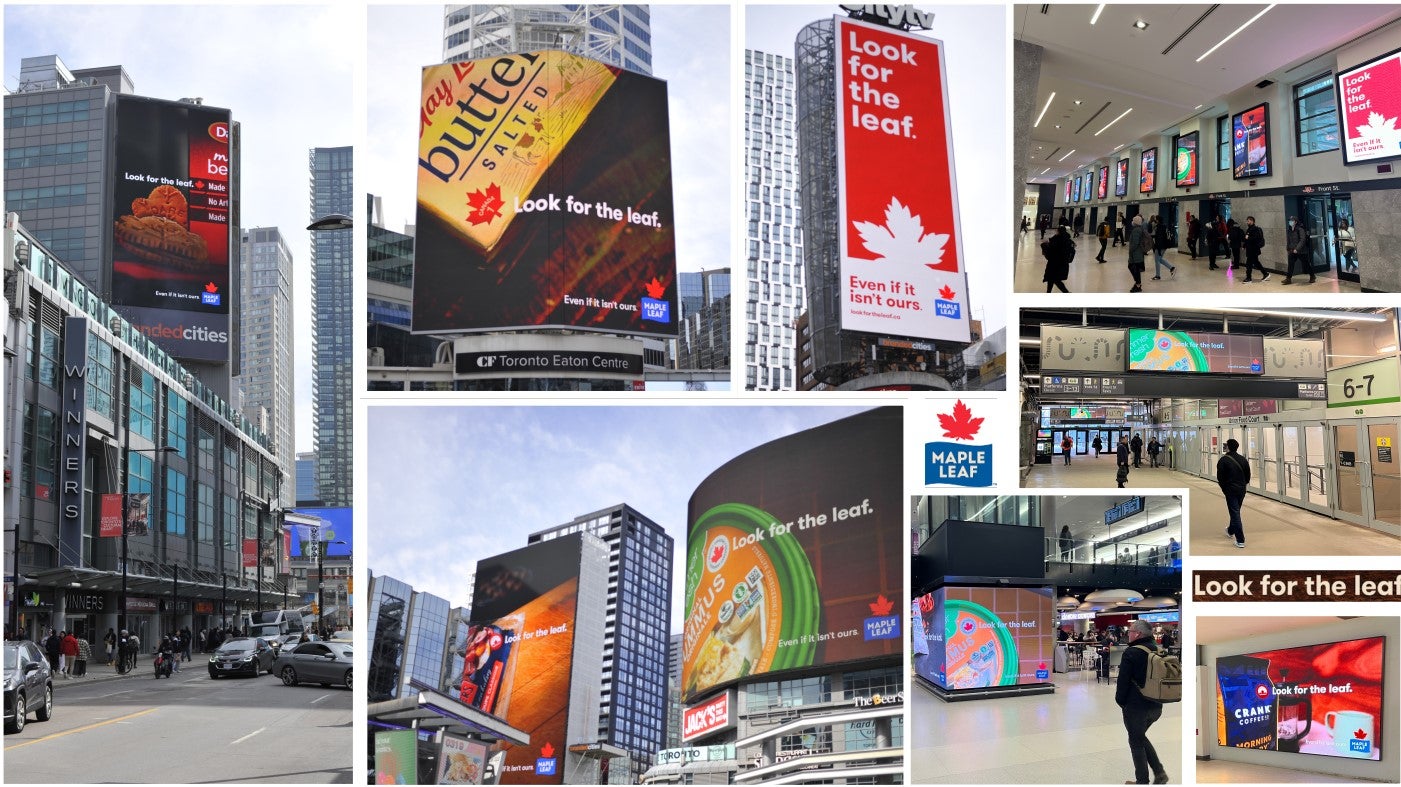
Maple Leaf Foods saw a lasting bump in sales from its efforts, along with improvements in other desired KPIs. In the 30 days after phase one ended, there was a more than 3,000% increase in online mentions and a 43% lift in brand engagement.
In addition, dozens of Canadian brands reached out to Maple Leaf Foods to say they wanted to participate in the next stage of the campaign, which coincided with Canada Day on July 1.
The collaborative nature of the campaign “helped mitigate aggressive pricing from competitors,” said Moore, since there was less of a need to one-up the brands that, historically, might have been viewed as opposition. Call it a truce.
Part two was “essentially taking [our] message to the streets,” said Moore, with a focus on out-of-home buy and news media.
Maple Leaf expanded its OOH efforts beyond Toronto to locations all across the country during the second phase. Major markets, including Toronto, Vancouver and Calgary, house most of Canada’s population, Moore explained, so out-of-home buys in those regions are particularly effective.
But what does “effective” mean for such an unorthodox media plan?
Some of the metrics for success were “atypical” with this campaign, Moore acknowledged.
“We wanted to spark a buzz amongst Canadian brands,” he said, which is why Maple Leaf tracked inbound “interest and requests” from competitor brands as an important measure of success.
And it wasn’t surprising that so many brands wanted to participate. The recent and ongoing geopolitical tumult has sparked a “huge wave of ‘buy Canadian’ national sentiment,” said Moore.
Maple Leaf Foods didn’t create that, he said. It just found the best way to propel the momentum forward.