
The ad industry’s hyper-fixation on performance means CMOs have to think and act more like investors. Their No. 1 mission is to prove returns on their investments.
Just about all ad platforms now pitch themselves as performance channels while marketers demand more proof that their ads drove demonstrable results. But just knowing that an ad performed isn’t good enough anymore, Christina Lowris Panos, CMO of luxury real estate firm The Corcoran Group, told AdExchanger. The Corcoran Group was founded by investor and “Shark Tank” star Barbara Corcoran in 1973. (Corcoran sold the business in the early 2000s, and, hilariously enough, did not initially invest the payout.)
Fast-forward to this decade, Panos said brands need to understand why their ads performed so they can avoid ad waste by focusing their efforts on only the strategies that they know will work. In The Corcoran Group’s case, she said, it wants to centralize ad dollars to ad plans that give the brand higher odds of ultimately selling a piece of property.
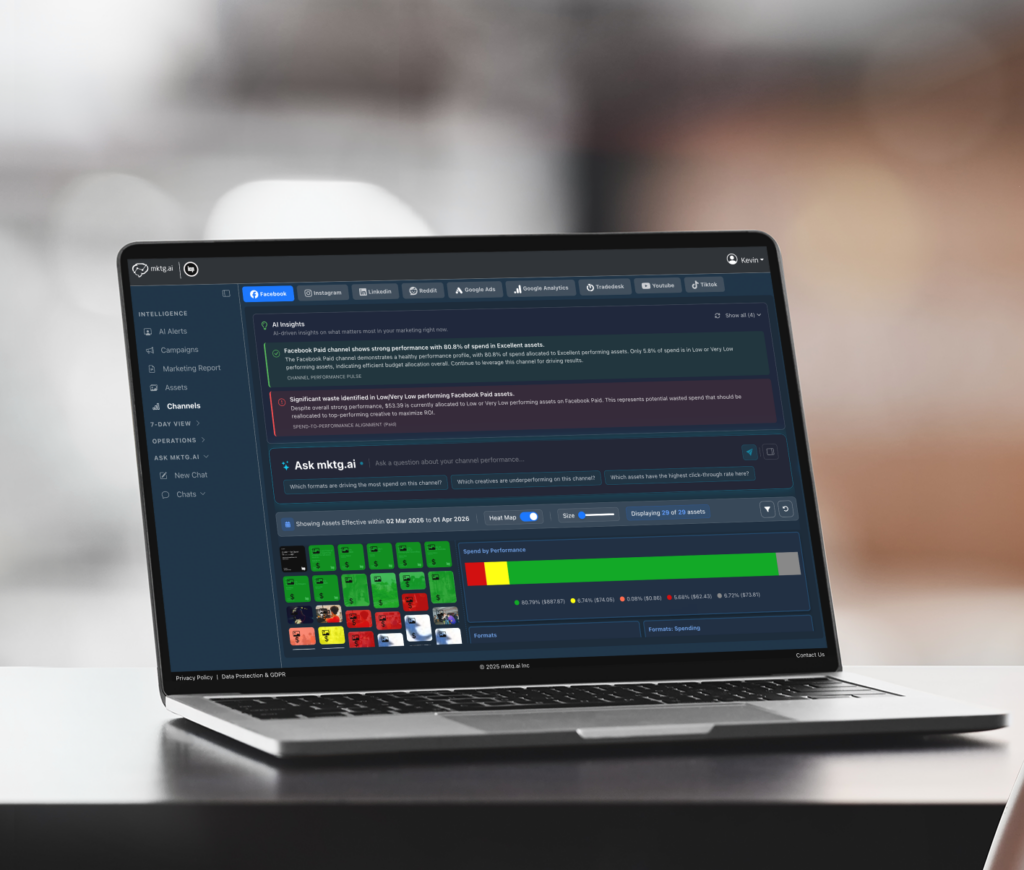
To get a better sense of why certain campaigns work better than others, The Corcoran Group tapped an AI-based marketing insights startup called mktg.ai (pronounced “marketing.ai”). Founded in 2024, the startup aggregates a marketer’s campaign data across platforms into a centralized dashboard that uses color-coding to depict which ads are performing best and why.
When marketers quickly understand why an ad performed well, they can build creatives that are more likely to interest intended customers inundated with challenger brand ads and rampant AI-generated content, said Kevin Wassong, founder and CEO of mktg.ai.
Show me the money
Fun fact: Wassong pitched the mktg.ai platform as an idea 25 years ago to WPP’s board, which he was part of at the time. WPP passed then, but mktg.ai was eventually born in 2024. The Corcoran Group is using the company’s latest creative intelligence platform, which became generally available in April this year.
The creative intelligence platform compiles data from a brand’s chosen marketing channels and demand-side platforms via APIs so marketers can apply consistent performance metrics across channels. For example, mktg.ai has direct integrations with The Trade Desk; ad platforms, such as Meta and Google; social media apps, including TikTok; and online publishers, such as LinkedIn and Reddit, to name a few. The platform also pulls data from other channels or publishers that are part of a marketer’s media plan but lack standardized APIs to plug into, such as TV networks or out-of-home campaigns.
“We are not a DAM [digital asset manager]; we capture what audiences have ultimately been exposed to,” Wassong said. The mktg.ai platform color-codes campaigns using shades of green, yellow and red to convey whether ad creatives are performing well or poorly and which creatives are seeing velocity in growth based on attributes such as cost and click-through rate. The platform’s metrics of success are designed to be relevant and applicable across platforms, from reach and frequency counts to the tone and the color schemes within a given video.
Getting quick and comprehensive marketing analytics feels especially significant for The Corcoran Group because the brand needs to ensure that its marketing is consistent across the brand itself and the agents handling the transactions while still playing to the individuals’ strengths.
The quicker The Corcoran Group can get a detailed and comprehensive breakdown of what did and did not work in its ad campaigns, Panos said, the better equipped the brand is to “maintain consistency in advertising our brand alongside agents and listings.”
For example, The Corcoran Group can tell which variables in a creative contributed to higher- or lower-than-expected performance, such as brightness levels, the color palette of the background, the location and angle of the recording and the mannerisms of the agent or actor in a particular ad, she said.
The ability to conduct “an autopsy of each video really helps us be better at producing content,” Panos said, which is especially important when it comes to relaying those insights to the agents who work with The Corcoran Group.
“Without the agent, there is no sale,” Panos said, so it’s critical that the company is able to share more information and guidance with agents about creating content that hits on what customers appear to be looking for.
After all, one of the biggest challenges for any brand trying to optimize its media strategy is having to kill some darlings or rethink a seemingly tried-and-true strategy. Cross-channel campaign data, when comprehensive and delivered quickly, is the “ultimate arbiter” of what consumers do and do not want to see, Panos said. In turn, she added, The Corcoran Group can switch tracks quickly to reduce ad waste and focus its efforts on the strategies that work best.
For example, The Corcoran Group was surprised to see that a recent video campaign featuring its CEO speaking inside of a property performed especially well. “We don’t do that often,” Panos said, but the ability to compare detailed campaign results across platforms in one place was reason enough to make the brand consider changing its ways.
So far, Panos said, the insights it harvested from mktg.ai inspired The Corcoran Group to shift its focus to marketing specific real estate properties such as townhouse facades based on which campaigns performed better. Panos said The Corcoran Group also recently created social-focused video series with the agents or featured personalities that outperformed the others based on data from mktg.ai.
The number of The Corcoran Group’s Instagram videos that the app ranked “Good” or “Excellent” rose to 286 so far this year, according to the brand, which is up from 200 in 2025.
“The best-performing videos for us are the ones that are unfiltered, off-the-cuff and authentic,” Panos said. While that tip is not surprising, she added, “you need that extra vote of confidence” when every media dollar needs to work harder.
Moving forward, Panos said, The Corcoran Group is eager to expand the brand’s scope beyond online and social video to include more traditional media, such as print and out-of-home.