

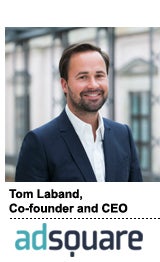
 Mobile audience targeting firm adsquare has secured a $4.3 million Series A funding, led by Target Partners and existing investors. The Berlin-based company will use the money to fuel international growth with new offices opening in the UK and France, in addition to driving product development.
Two years ago, the founders built adsquare in response to what CEO Tom Laband describes as “a lack of targeting capabilities on mobile in the German marketplace” at that time. “Our targeting approach is about location,” he added, “and the idea is that location is a very good indicator of consumer behavior.”
Adsquare maps users across Europe and segments audiences into geographic sections dubbed “squares,” each of which measures 50 by 50 meters. The firm uses 2,000 data points per square to derive the context of audiences within each geofence. The company then offers that data to a host of ad networks and advertising, supply-side and demand-side platforms for real-time audience targeting.
Adsquare is integrated with AppNexus and for the most part works directly with trading desks through the AppNexus console, but it also works with advertisers that have existing tech stacks in place, like Vodafone, Europcar, HRS and Deutsche Bahn. Before this most recent round of fundraising, the company had raised $1.3 million in seed money.

Adsquare’s offering echoes other technology companies’ efforts to solve the cross-device identification puzzle in a cookie-less advertising ecosystem. Facebook is arguably ahead of the pack with its rebuilt Atlas ad server, and though adsquare’s offering differs, Laband said the targeting capabilities share certain attributes.
“Our clients say to us that we’re building the cookie of the real world,” Laband told AdExchanger. “Adsquare’s offering is not exactly comparable to what Facebook does because whenever you’re logged into Facebook, they know everything about you. But where we’re similar is that we use time and location for user targeting. Facebook’s approach is way broader, but they do track users across mobile and desktop. At adsquare, at the moment, we focus on mobile inventory.”
Unlike Facebook, adsquare is primarily a data provider and does not sell media on its own. The company’s cross-device user data is also anonymous, which Laband describes as a “privacy-friendly approach” that’s necessary to succeed in the German marketplace.
Privacy is a hot topic in ad land at the moment, and has been a particularly sticky issue in Germany. The privacy mandate out of Hamburg earlier this month was a testament to that.
“Germany has one of the strictest privacy laws worldwide,” Laband explained. “From day one, we built the adsquare platform with privacy at the core of its design. What we can see now is a greater awareness of privacy, which means many companies need to shift their approach to privacy. We have a market advantage compared to other companies because of this.”
To comply with privacy mandates, adsquare files users into marketable categories. For example, if a user has been to the cinema five times in the past year, adsquare doesn’t save that information specifically. Instead, adsquare would segment that user into an entertainment category and parcel that category out to marketers in a way that’s in line with privacy laws.
Even with the uncertainty surrounding ad profiles and targeting, the German ad tech ecosystem has seen a lot of activity in recent months. In October, AppLovin acquired Germany mobile ad network moboqo. In another example, European media company RNTS Media snapped up Berlin-based ad tech firm Fyber. And recent funding rounds include $7.6 million for analytics firm Adjust and a $1 million seed round for Remerge, an app retargeting platform.









