 This is part of a series on companies advancing programmatic buying in Russia. Read our recent Q&As with Yandex, ADFOX, AiData, HubRus and Between Digital.
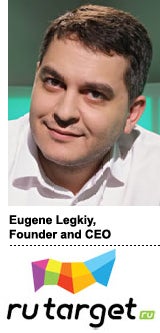
Even with a growing Russian programmatic market, RuTarget’s founder and CEO Eugene Legkiy claims its greatest competition comes from without – from global players like IPONWEB, OpenX and AppNexus.
Global companies trying to make inroads are struggling, he said, because of language barriers and because business opportunities are biased toward local and regional players.
But this will eventually change.
In the meantime, the 15-employee strong RuTarget, which launched in 2011, will work to extend its business providing data management tools for demand-side platforms (DSPs), ad networks and agencies.
“RuTarget develops programmatic solutions, mostly on the demand side and less on the supply side,” Legkiy said. “We work to analyze big data [and] predict new trends and behaviors based on the data and then target communications based on that data.”
He added that RuTarget processes “more than 1 billion data points locally in Russia and we see each and every person online in Russia more than 30 times a day.”
Legkiy spoke to AdExchanger about the work RuTarget’s plans for growth for the company and how international players are moving into the Russian programmatic space.

AdExchanger: Who are your customers and what are your products?
EUGENE LEGKIY: Our main products in the advertising space are DSP and ad networks solutions. One of the first products we made was for Segmento. Segmento is like Rocket Fuel in Russia and it was our first partner.
Mainly, we serve advertising agencies, publishers and banks that have big demand for data analysis and behavior analysis. We have a number of global customers, also agencies that want to bring in their solutions to Russia. Other clients are a number of banks that have big data solutions. And a number of publishers, including a big social network, [that] want to unlock their data as well.
What is the programmatic space like in Russia right now?
There is growth. We expect that in 2014, programmatic will take a 10% share of display advertising and maybe it will take up to 15%, depending on the global economic state. I think it can grow even quicker because we see many offline businesses in Russia going digital overall. The demand is growing, but we also see global brands that have adopted programmatic in international scale are now starting to ask local departments about the programmatic strategy in Russia. “Why don’t we have it here in Russia?” So that has accelerated the trend.
How are digital newcomers like Russian banks starting to harness data and programmatic concepts?
Tinkoff Bank started [Tinkoff Digital] to start advertising, and they have DSP technology. They use it successfully now for the bank. Using digital advertising as a new customer acquisition channel can change the game drastically. Every bank is now asking, “What can we do? How we can take online data and use it for our products like loans and so on? How we can use it for scoring and evaluating the effectiveness of our bank’s portfolio?”
The second trend is they ask, “How can we use our data that we have on our customers to acquire more or maybe have some type of advertising business on the side?” They see global companies like American Express successfully use their transaction data to target the most valuable audiences online. We work with a number of banks on these two trends, making and helping to create technology for them.
Do you see a lot of international companies trying to launch in Russia or is it still mostly domestic players?
There is some hype about Russia right now. From the demand side, there are both big Russian players and big international players, like Google. Its ad network, AdWords, competes in this space for marketer dollars. But locally, there is Yandex, which is bigger here and is trying to pass Google in RTB so it opened up its inventory.
Also, ad networks are trying to stay in the market and be innovative, to build some technology. We see the big ad networks in Russia are moving into the RTB space. There are branches of international DSPs, but they are not independent. The Russian market is very closed in terms of language and relations in business, so they try, but I don’t see success right now. Eventually, it will be a thing.
Also, we see regular retargeting platforms, like Criteo and Sociomantic, coming from Europe into Russia. They are successful because it’s the low-hanging fruit of ecommerce and performance.
What are your goals for RuTarget over the next year to 18 months?
We have an Asian project and we want to expand more in Asia. We are going to launch in the European and Eastern markets as well to provide technology.
We will eventually introduce our self-service platform in a year or so. We are mostly working on cutting-edge technology solutions that don’t have demand now, but we will have that demand within a year. We are creating new ways of using data in new channels and even offline channels and bringing offline to online and connecting it together. We continue to invest in our technology and our solutions that we provide to the market.