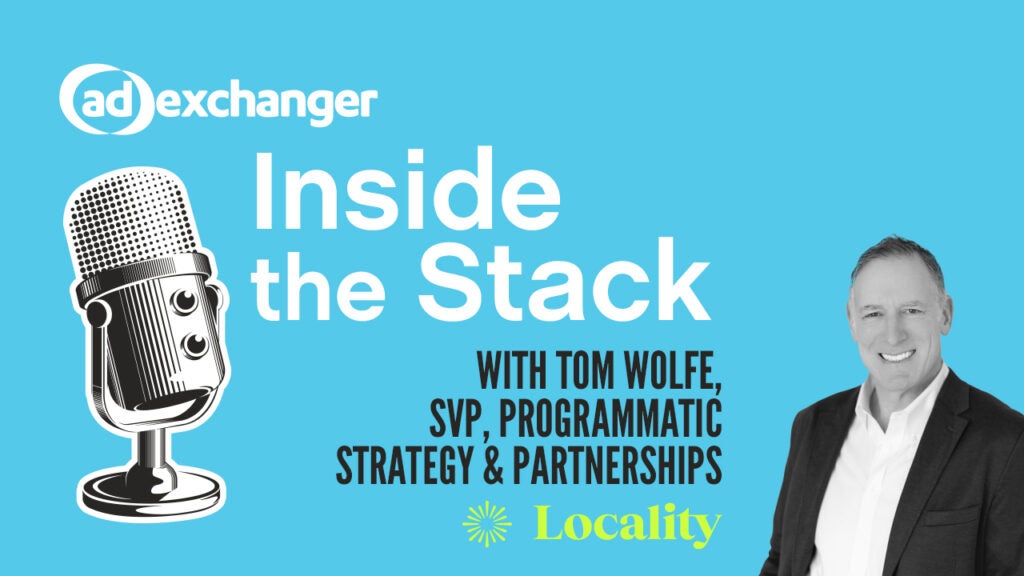
Home Inside the Stack Locality’s Tom Wolfe On Why Top-Down National TV Strategies Fail In Local Markets

Locality’s Tom Wolfe On Why Top-Down National TV Strategies Fail In Local Markets

SHARE:

Supply path optimization (SPO) has become industry shorthand for aggressive fee-cutting and stripping out intermediaries. But according to Tom Wolfe, Senior Vice President of Programmatic Strategy and Partnerships at Locality, that’s only half the equation.

Wolfe’s point on this episode of AdExchanger’s Inside the Stack is that a shorter path is better, and it’s even better when there’s premium inventory on the other side of it. While reducing the tech tax matters, a hyper-focus on cutting hops often ignores the signal degradation and data loss that happens when inventory bounces across multiple fragmented systems.

Wolfe argues buyers need to pair SPO with what he calls “data path optimization”: making sure the rich signals traveling alongside the inventory survive the trip, so the shorter path actually leads somewhere worth going.

Local TV adds an entirely different layer of complexity, and Wolfe points out the flaws in how buyers currently approach it. Taking a top-down national strategy and trying to force-fit it into distinct local markets simply doesn’t work.

As Wolfe notes, an auto-intender navigating the dense, brick-lined streets of Philadelphia behaves vastly differently than one driving the dirt roads of Dothan, Alabama. Hitting those distinct audiences requires bottom-up market intelligence that simple zip-code targeting can’t replicate.

In this episode, Wolfe also takes aim at the ubiquitous AI hype, arguing that the true competitive advantage isn’t the AI itself. Comparing today’s AI platforms to everyone suddenly gaining access to Microsoft Excel in the 90s, Wolfe points out that the real differentiator is the data feeding the models.

Tune in to hear more about solving local TV fragmentation, why AI is useless without good bidstream signals, and Wolfe’s three words to describe the converging TV ecosystem.


Must Read

AdExchanger's Big Story podcast with journalistic insights on advertising, marketing and ad tech

The Apple Bites Back

Apple has a new block list for data brokers and ad tech vendors that do cross-site user tracking – which could expand to include a much broader slate of ad tech and martech vendors across the entire ecosystem. Plus: a few thoughts on Advertising Week New York.

How Data And Ad Tech Vendors Are Preparing For The iOS 27 Fallout

Against the backdrop of Advertising Week New York this week, the programmatic ecosystem has been buzzing madly like the inhabitants of an overturned beehive after the release of Apple’s iOS 27.

How Does Agentic Buying Work In CTV?

Given how much agentic AI pervades nearly every conversation these days, it’s easy to overlook how nascent the technology still is, particularly when it comes to buying ads on connected TV.

Privacy! Commerce! Connected TV! Read all about it. Subscribe to AdExchanger Newsletters
Patrick Dolan, Chief Operating Officer, OAAA

How The OAAA Is Guiding DOOH Through Its Next Stage Of Programmatic Evolution

OAAA COO Patrick Dolan explains how the organization is changing to guide the out-of-home channel through programmatic’s agentic era.

PubX Raises $5 Million And Buys Digital Governance Startup Compliant

PubX has acquired media-quality startup Compliant and raised a $5 million Series A as it expands its agentic ad-buying platform into the US.

New WBD Report Makes The Case For Getting The Measurement Basics Right

Warner Bros. Discovery has a new white paper analyzing the data and methodologies of five top video measurement providers: VideoAmp, iSpot, Comscore, Innovid and Samba.



